Wages are tracking as expected

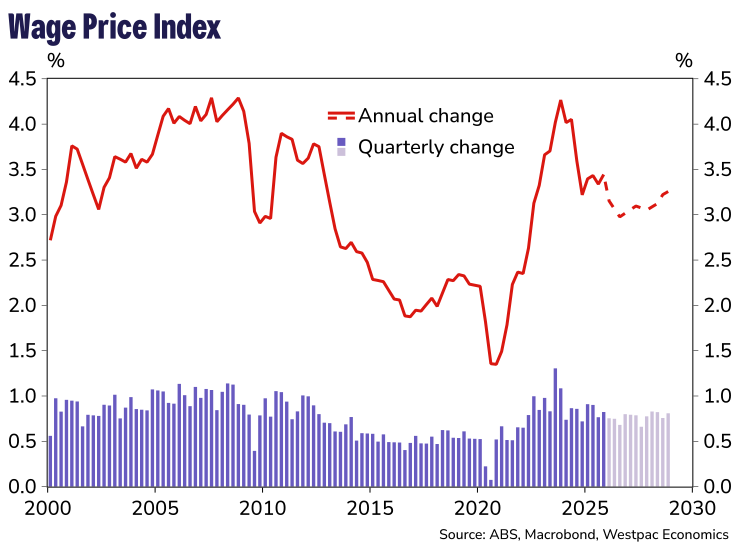
The Wage Price Index rose 0.8% in the December quarter, matching Westpac, market and RBA expectations, marking a second consecutive quarter at this pace and a clear step down from the 0.9% outcomes earlier in 2025. Health care & social assistance and education & training accounted for the bulk of wage growth, reflecting Commonwealth‑funded initiatives in aged care and early childhood education, alongside scheduled public sector enterprise agreement increases. Absent the outsized lift in health care wages, quarterly WPI growth would likely have been closer to 0.7%. While labour costs have grown faster than the WPI, key temporary drivers have now peaked. Westpac expects wages growth to continue easing, with the annual WPI slowing to around 3.0% by late 2026, though the RBA is likely to remain cautious given weak productivity outcomes.

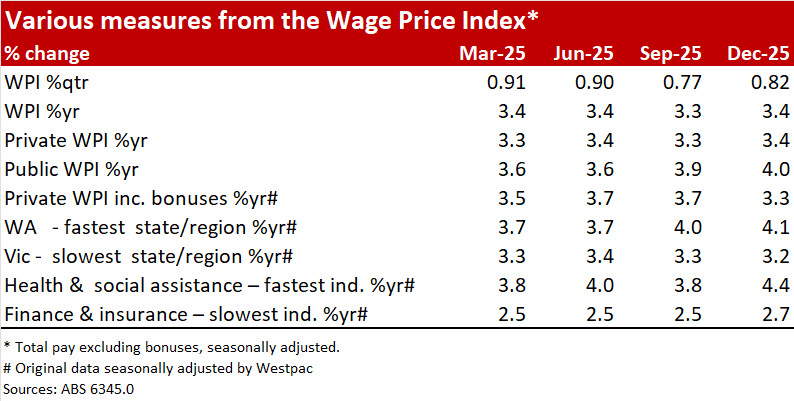
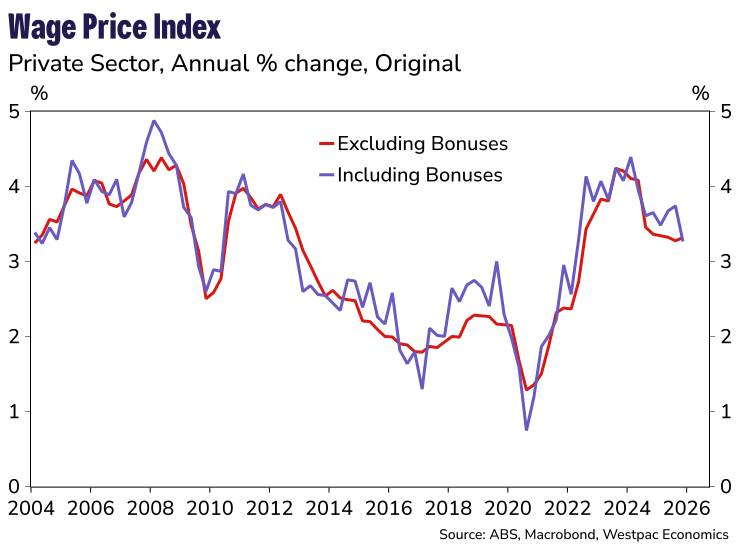
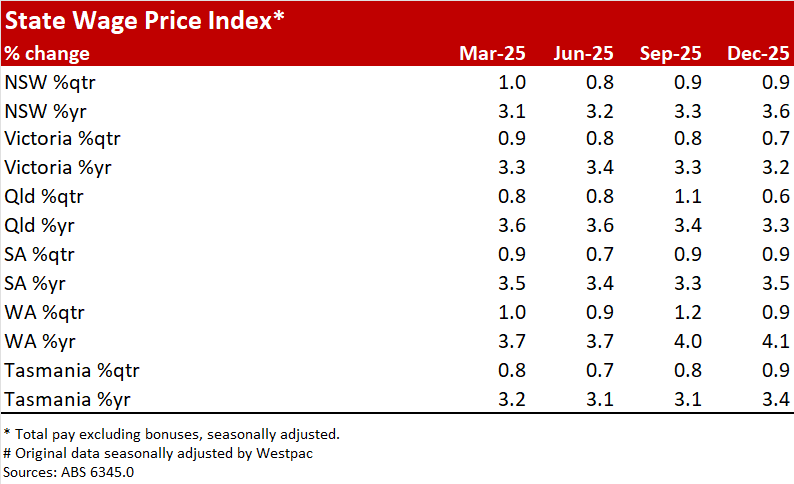
The Wage Price Index (WPI) rose 0.8% in the December quarter, on par with Westpac’s estimate, the market consensus and what we can interpret as the RBA’s expectation. While the annual pace reportedly lifted from 3.3%yr in September to 3.4%yr in December, this was largely due to regular revisions of seasonal factors which revised down September’s print. Importantly, we have now seen two quarters of 0.8%, a step down from the 0.9%qtr prints in the first half of 2025, with the six-month annualised pace dropping from 3.7%yr in June to 3.2%yr in December.
The ABS noted a higher proportion of jobs recorded a wage increase this December quarter compared to 2024; 21% in 2025 vs. 16% in 2024. However, the average was less at 3.5% compared to 3.6% in 2024.
Private sector wages increased by 0.8%qtr, matching both the June and September quarters, seeing the annual pace remain broadly stable at 3.4%yr. It is worth nothing that the measure of private sector wages including bonuses softening, with the annual rate dropping from 3.8%yr in September to 3.3%yr in December, the slowest pace since 2.6%yr in March 2022.
The private sector saw a larger share (19% of jobs) get a wage increase this December compared to a year earlier (14%) but the wage increase was the same at 3.7%.
Wages in the public sector also lifted 0.8%qtr, raising the annual pace from 3.9%yr in September to 4.0%yr in December. The most recent peak in public sector wage inflation was 4.3%yr back in December 2023. The share of public sector jobs getting a wage increase in December increased to 29% from 23% a year earlier but the average wage increase moderated from 3.3% to 3.1%. over 2025, we have seen a drop in the average wage increase paid in a quarter: it was 3.3% in March, then lifted to 3.5% in June and now it has been 3.1% in both the September and December quarters.
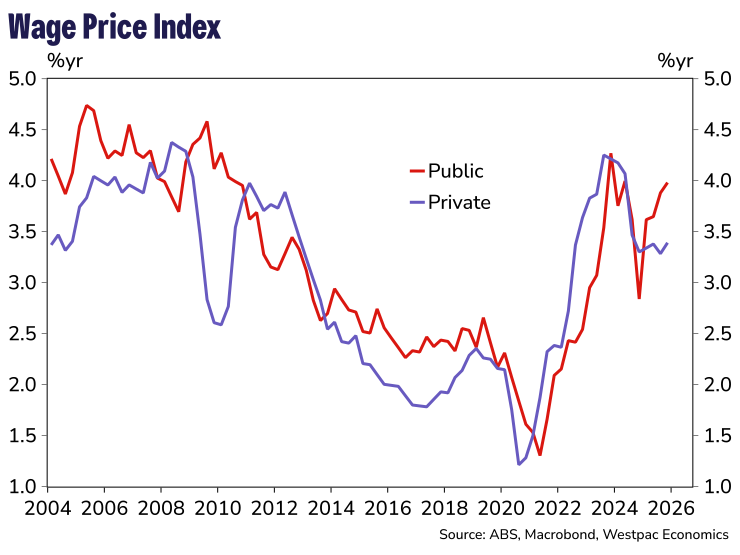
It was again the state governments that made the largest contribution to public sector wages growth, reflecting the overall number of employees and total wage expenditure (state governments are the largest public sector employers) and the size of any wage increase that occurred. In the December quarter, state government contributed 89% of the public sector wage growth. Meanwhile, the Federal government contributed just 10% – most Commonwealth employees get a wage increase in the June quarter, and this year, that increase was responsible for 44% of the quarterly lift in public sector wages.
Wages are tracking much as we and the RBA were expecting. There are, however, a couple of interesting issues to consider. The largest contribution to the print was 0.18ppt from health care & social assistance. The next largest was a 0.07ppt contribution from education & training.
The ABS noted that healthcare & social assistance was the main contributor to wages growth for both the private (health care & social assistance may be public funded but the service is often via a private provider) and public sector this quarter. There were two major Commonwealth funded initiatives in aged care and early childhood care & education, which led to wage increases the private sector for this industry. The ABS also noted that growth in the public sector was largely related to scheduled enterprise agreement rises paid to frontline health care workers across NSW.
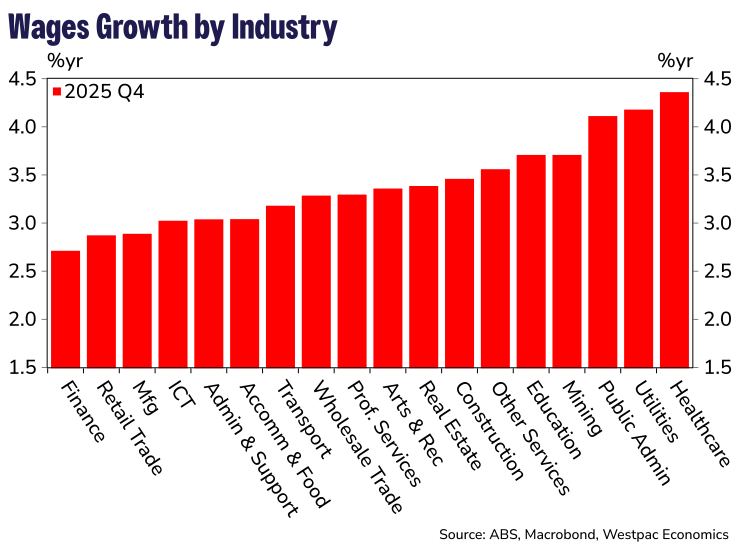
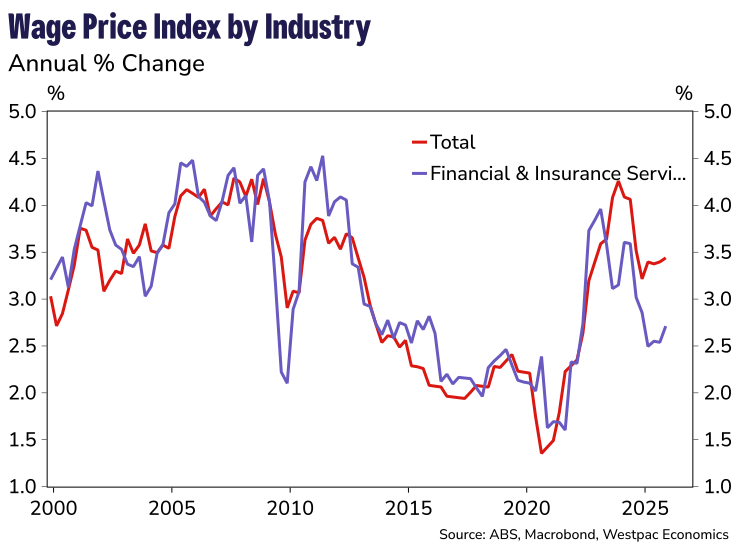
Health & social assistance wage increases have been outstripping other industries for some time; it reported the highest annual pace at 4.4%yr. Westpac seasonally adjusts the industry data, and this finds this sector had the largest wage increase in the December quarter of 1.0%. The next highest at 0.9% were mining, utilities, construction, transport & warehousing, education & training, and other services.
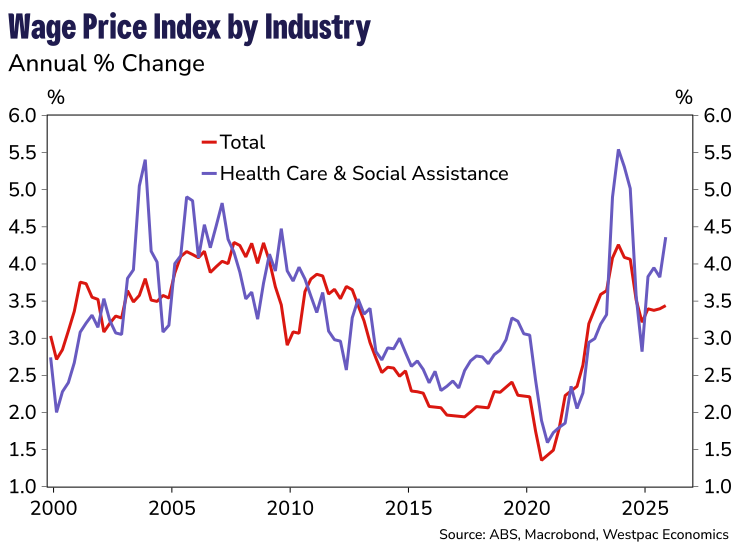
Had it not been for the boost from health care & social assistance wages (i.e. if the increase in this sector was more like the national average) we believe the WPI increase in the quarter would have been closer to 0.7%.
Overall, Westpac is not particularly concerned about inflationary risks from wages. While total labour costs as reported in the National Accounts have been growing somewhat faster than the WPI, there are several factors that suggest the total wage bill measures of labour costs are set to moderate. In particular, the escalation in the Super Guarantee has added 0.5ppt/yr to overall labour cost growth in recent years but we are now at the legislated peak rate, there will be no increase this year, or any year ahead as the legislation currently stands.
Nevertheless, we expect that the RBA will continue to assess that labour cost growth is still strong enough to present a concern to the inflationary outlook given their relatively pessimistic view about productivity.
Westpac is expecting the annual pace of the WPI to be down to around 3.0%yr by December quarter of 2026.
Wages by bargaining stream
Westpac has long believed focusing on wage inflation by wage bargaining stream can help to understand how wages respond to the economic cycle. Long term readers would know that the Australian labour market is split into three categories of pay setting methods:
- Awards,
- Enterprise agreements, or
- Individual arrangements.
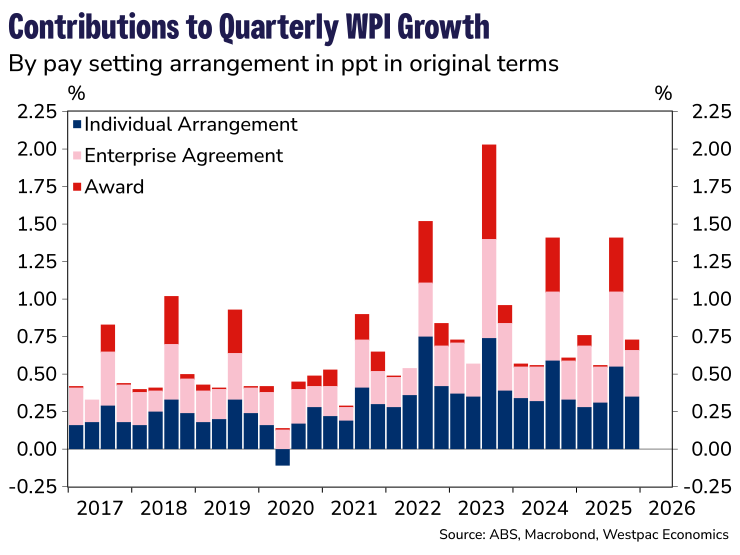
In original terms, the WPI lifted 0.7% in the December quarter. The largest share of Australian wage adjustments tends to occur in the September quarter with July being the start of the new financial year. The following data is reported in original (not seasonally adjusted) terms.
Of the 0.7% increase in the WPI, jobs covered by Individual Arrangements made the largest contribution at 0.35ppt, compared to 0.31ppt for Enterprise Agreements and 0.07ppt for Awards/Minimum wage. With most individually arranged pay setting occurring in the private sector, this stream has an outsized influence on private sector wages.
Westpac estimates that the average wage increase for Individually Arranged wages was 0.7% in December, on par with December 2024 thus holding the annual pace flat at 3.1%.
For the December quarter, Westpac estimates that Enterprise Agreement wages lifted 0.8%, up modestly from the 0.7% increase in December 2024 and thus seeing the annual pace lift from 3.7%yr to 3.9%yr.
The September quarter is also when we see the annual adjustment to Awards and the Minimum Wage. In 2025 the Fair Work Commission Annual Wage Review provided a 3.5% increase 1 July 2025. This was lower than the 3.75% provided in 2024 and the 5.75% decision in 2023. We expect that the 0.5% increase in Awards rates of pay in the December quarter would relate to the two major Commonwealth funded initiatives in aged care and early childhood care & education which we noted earlier. The 0.5% increase this year was larger than the 0.1% increase in December 2024 taking the annual pace to 3.9% (the fastest pace since 5.4%yr in June 2024) from 3.7%yr.
Wages by industry
Industry contributions to wage growth reflect the size of the industry as defined by total wage expenditure as well as the size of the wage change that occurred.
The following data is represented in seasonal adjusted estimates produced by Westpac:
- Healthcare & social assistance had the strongest quarterly and annual pace of wage inflation (1.0%qtr/4.4%yr).
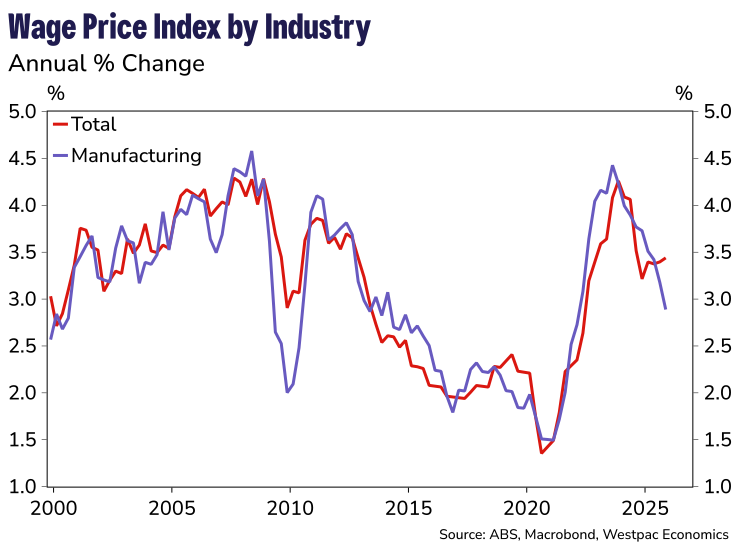
- Public administration & safety and manufacturing were tied for the lowest quarterly rise in wages at 0.5%qtr but (0.6%qtr) but public administration still reported an above average annual pace (4.1%yr) compared to a very anaemic annual pace in manufacturing (2.9%yr).
Stay informed with Westpac IQ
Get the latest reports straight to your inbox.
Related articles
Private sector wages moderating as expected
Wages are not a risk to the RBA outlook
Browse topics
Disclaimer
©2026 Westpac Banking Corporation ABN 33 007 457 141 (including where acting under any of its Westpac, St George, Bank of Melbourne or BankSA brands, collectively, “Westpac”). References to the “Westpac Group” are to Westpac and its subsidiaries and includes the directors, employees and representatives of Westpac and its subsidiaries.
Things you should know
We respect your privacy: You can view the New Zealand Privacy Policy here, or the Australian Group Privacy Statement here. Each time someone visits our site, data is captured so that we can accurately evaluate the quality of our content and make improvements for you. We may at times use technology to capture data about you to help us to better understand you and your needs, including potentially for the purposes of assessing your individual reading habits and interests to allow us to provide suggestions regarding other reading material which may be suitable for you.
This information, unless specifically indicated otherwise, is under copyright of the Westpac Group. None of the material, nor its contents, nor any copy of it, may be altered in any way, transmitted to, copied of distributed to any other party without the prior written permission of the Westpac Group.
Disclaimer
This information has been prepared by Westpac and is intended for information purposes only. It is not intended to reflect any recommendation or financial advice and investment decisions should not be based on it. This information does not constitute an offer, a solicitation of an offer, or an inducement to subscribe for, purchase or sell any financial instrument or to enter into a legally binding contract. To the extent that this information contains any general advice, it has been prepared without taking into account your objectives, financial situation or needs and before acting on it you should consider the appropriateness of the advice. Certain types of transactions, including those involving futures, options and high yield securities give rise to substantial risk and are not suitable for all investors. We recommend that you seek your own independent legal or financial advice before proceeding with any investment decision.
This information may contain material provided by third parties. While such material is published with the necessary permission none of Westpac or its related entities accepts any responsibility for the accuracy or completeness of any such material. Although we have made every effort to ensure this information is free from error, none of Westpac or its related entities warrants the accuracy, adequacy or completeness of this information, or otherwise endorses it in any way. Except where contrary to law, Westpac Group intend by this notice to exclude liability for this information. This information is subject to change without notice and none of Westpac or its related entities is under any obligation to update this information or correct any inaccuracy which may become apparent at a later date. This information may contain or incorporate by reference forward-looking statements. The words “believe”, “anticipate”, “expect”, “intend”, “plan”, “predict”, “continue”, “assume”, “positioned”, “may”, “will”, “should”, “shall”, “risk” and other similar expressions that are predictions of or indicate future events and future trends identify forward-looking statements. These forward-looking statements include all matters that are not historical facts. Past performance is not a reliable indicator of future performance, nor are forecasts of future performance. Whilst every effort has been taken to ensure that the assumptions on which any forecasts are based are reasonable, the forecasts may be affected by incorrect assumptions or by known or unknown risks and uncertainties. The ultimate outcomes may differ substantially from any forecasts.
Conflicts of Interest: In the normal course of offering banking products and services to its clients, the Westpac Group may act in several capacities (including issuer, market maker, underwriter, distributor, swap counterparty and calculation agent) simultaneously with respect to a financial instrument, giving rise to potential conflicts of interest which may impact the performance of a financial instrument. The Westpac Group may at any time transact or hold a position (including hedging and trading positions) for its own account or the account of a client in any financial instrument which may impact the performance of that financial instrument.
Author(s) disclaimer and declaration: The author(s) confirms that (a) no part of his/her compensation was, is, or will be, directly or indirectly, related to any views or (if applicable) recommendations expressed in this material; (b) this material accurately reflects his/her personal views about the financial products, companies or issuers (if applicable) and is based on sources reasonably believed to be reliable and accurate; (c) to the best of the author’s knowledge, they are not in receipt of inside information and this material does not contain inside information; and (d) no other part of the Westpac Group has made any attempt to influence this material.
Further important information regarding sustainability-related content: This material may contain statements relating to environmental, social and governance (ESG) topics. These are subject to known and unknown risks, and there are significant uncertainties, limitations, risks and assumptions in the metrics, modelling, data, scenarios, reporting and analysis on which the statements rely. In particular, these areas are rapidly evolving and maturing, and there are variations in approaches and common standards and practice, as well as uncertainty around future related policy and legislation. Some material may include information derived from publicly available sources that have not been independently verified. No representation or warranty is made as to the accuracy, completeness or reliability of the information. There is a risk that the analysis, estimates, judgements, assumptions, views, models, scenarios or projections used may turn out to be incorrect. These risks may cause actual outcomes to differ materially from those expressed or implied. The ESG-related statements in this material do not constitute advice, nor are they guarantees or predictions of future performance, and Westpac gives no representation, warranty or assurance (including as to the quality, accuracy or completeness of the statements). You should seek your own independent advice.
Additional country disclosures:
Australia: Westpac holds an Australian Financial Services Licence (No. 233714). You can access Westpac’s Financial Services Guide here or request a copy from your Westpac point of contact. To the extent that this information contains any general advice, it has been prepared without taking into account your objectives, financial situation or needs and before acting on it you should consider the appropriateness of the advice.
New Zealand: In New Zealand, Westpac Institutional Bank refers to the brand under which products and services are provided by either Westpac (NZ division) or Westpac New Zealand Limited (company number 1763882), the New Zealand incorporated subsidiary of Westpac ("WNZL"). Any product or service made available by WNZL does not represent an offer from Westpac or any of its subsidiaries (other than WNZL). Neither Westpac nor its other subsidiaries guarantee or otherwise support the performance of WNZL in respect of any such product. WNZL is not an authorised deposit-taking institution for the purposes of Australian prudential standards. The current disclosure statements for the New Zealand branch of Westpac and WNZL can be obtained at the internet address www.westpac.co.nz.
Singapore: This material has been prepared and issued for distribution in Singapore to institutional investors, accredited investors and expert investors (as defined in the applicable Singapore laws and regulations) only. Recipients of this material in Singapore should contact Westpac Singapore Branch in respect of any matters arising from, or in connection with, this material. Westpac Singapore Branch holds a wholesale banking licence and is subject to supervision by the Monetary Authority of Singapore.
Fiji: Unless otherwise specified, the products and services for Westpac Fiji are available from www.westpac.com.fj © Westpac Banking Corporation ABN 33 007 457 141. This information does not take your personal circumstances into account and before acting on it you should consider the appropriateness of the information for your financial situation. Westpac Banking Corporation ABN 33 007 457 141 is incorporated in NSW Australia and registered as a branch in Fiji. The liability of its members is limited.
Papua New Guinea: Unless otherwise specified, the products and services for Westpac PNG are available from www.westpac.com.pg © Westpac Banking Corporation ABN 33 007 457 141. This information does not take your personal circumstances into account and before acting on it you should consider the appropriateness of the information for your financial situation. Westpac Banking Corporation ABN 33 007 457 141 is incorporated in NSW Australia. Westpac is represented in Papua New Guinea by Westpac Bank - PNG - Limited. The liability of its members is limited.
U.S.: Westpac operates in the United States of America as a federally licensed branch, regulated by the Office of the Comptroller of the Currency. Westpac is also registered with the US Commodity Futures Trading Commission (“CFTC”) as a Swap Dealer, but is neither registered as, or affiliated with, a Futures Commission Merchant registered with the US CFTC. The services and products referenced above are not insured by the Federal Deposit Insurance Corporation (“FDIC”). Westpac Capital Markets, LLC (‘WCM’), a wholly-owned subsidiary of Westpac, is a broker-dealer registered under the U.S. Securities Exchange Act of 1934 (‘the Exchange Act’) and member of the Financial Industry Regulatory Authority (‘FINRA’). In accordance with APRA's Prudential Standard 222 'Association with Related Entities', Westpac does not stand behind WCM other than as provided for in certain legal agreements between Westpac and WCM and obligations of WCM do not represent liabilities of Westpac.
This communication is provided for distribution to U.S. institutional investors in reliance on the exemption from registration provided by Rule 15a-6 under the Exchange Act and is not subject to all of the independence and disclosure standards applicable to debt research reports prepared for retail investors in the United States. WCM is the U.S. distributor of this communication and accepts responsibility for the contents of this communication. Transactions by U.S. customers of any securities referenced herein should be effected through WCM. All disclaimers set out with respect to Westpac apply equally to WCM. If you would like to speak to someone regarding any security mentioned herein, please contact WCM on +1 212 389 1269. Investing in any non-U.S. securities or related financial instruments mentioned in this communication may present certain risks. The securities of non-U.S. issuers may not be registered with, or be subject to the regulations of, the SEC in the United States. Information on such non-U.S. securities or related financial instruments may be limited. Non-U.S. companies may not be subject to audit and reporting standards and regulatory requirements comparable to those in effect in the United States. The value of any investment or income from any securities or related derivative instruments denominated in a currency other than U.S. dollars is subject to exchange rate fluctuations that may have a positive or adverse effect on the value of or income from such securities or related derivative instruments.
The author of this communication is employed by Westpac and is not registered or qualified as a research analyst, representative, or associated person of WCM or any other U.S. broker-dealer under the rules of FINRA, any other U.S. self-regulatory organisation, or the laws, rules or regulations of any State. Unless otherwise specifically stated, the views expressed herein are solely those of the author and may differ from the information, views or analysis expressed by Westpac and/or its affiliates.
UK: The London branch of Westpac is authorised in the United Kingdom by the Prudential Regulation Authority (PRA) and is subject to regulation by the Financial Conduct Authority (FCA) and limited regulation by the PRA (Financial Services Register number: 124586). The London branch of Westpac is registered at Companies House as a branch established in the United Kingdom (Branch No. BR000106). Details about the extent of the regulation of Westpac’s London branch by the PRA are available from us on request.
This communication is not being made to or distributed to, and must not be passed on to, the general public in the United Kingdom. Rather, this communication is being made only to and is directed at (a) those persons falling within the definition of Investment Professionals (set out in Article 19(5) of the Financial Services and Markets Act 2000 (Financial Promotion) Order 2005 (the “Order”)); (b) those persons falling within the definition of high net worth companies, unincorporated associations etc. (set out in Article 49(2)of the Order; (c) other persons to whom it may lawfully be communicated in accordance with the Order or (d) any persons to whom it may otherwise lawfully be made (all such persons together being referred to as “relevant persons”). Any person who is not a relevant person should not act or rely on this communication or any of its contents. In the same way, the information contained in this communication is intended for “eligible counterparties” and “professional clients” as defined by the rules of the Financial Conduct Authority and is not intended for “retail clients”. Westpac expressly prohibits you from passing on the information in this communication to any third party.
European Economic Area (“EEA”): This material may be distributed to you by either: (i) Westpac directly, or (ii) Westpac Europe GmbH (“WEG”) under a sub-licensing arrangement. WEG has not edited or otherwise modified the content of this material. WEG is authorised in Germany by the Federal Financial Supervision Authority (‘BaFin’) and subject to its regulation. WEG’s supervisory authorities are BaFin and the German Federal Bank (‘Deutsche Bundesbank’). WEG is registered with the commercial register (‘Handelsregister’) of the local court of Frankfurt am Main under registration number HRB 118483. In accordance with APRA’s Prudential Standard 222 ‘Association with Related Entities’, Westpac does not stand behind WEG other than as provided for in certain legal agreements (a risk transfer, sub-participation and collateral agreement) between Westpac and WEG and obligations of WEG do not represent liabilities of Westpac. Any product or service made available by WEG does not represent an offer from Westpac or any of its subsidiaries (other than WEG). All disclaimers set out with respect to Westpac apply equally to WEG.
This communication is not intended for distribution to, or use by any person or entity in any jurisdiction or country where such distribution or use would be contrary to local law or regulation.
This communication contains general commentary, research, and market colour. The communication does not constitute investment advice. The material may contain an ‘investment recommendation’ and/or ‘information recommending or suggesting an investment’, both as defined in Regulation (EU) No 596/2014 (including as applicable in the United Kingdom) (“MAR”). In accordance with the relevant provisions of MAR, reasonable care has been taken to ensure that the material has been objectively presented and that interests or conflicts of interest of the sender concerning the financial instruments to which that information relates have been disclosed.
Investment recommendations must be read alongside the specific disclosure which accompanies them and the general disclosure which can be found here. Such disclosure fulfils certain additional information requirements of MAR and associated delegated legislation and by accepting this communication you acknowledge that you are aware of the existence of such additional disclosure and its contents.
To the extent this communication comprises an investment recommendation it is classified as non-independent research. It has not been prepared in accordance with legal requirements designed to promote the independence of investment research and therefore constitutes a marketing communication. Further, this communication is not subject to any prohibition on dealing ahead of the dissemination of investment research.