Government’s footprint plateaus as its inflationary impulse begins to fade

Public spending (state and federal) continues to support around 35% of domestic activity and nearly 40% of employment.

The government footprint remains stable near record highs. Public spending (state and federal) continues to support around 35% of domestic activity and nearly 40% of employment. But the mix is shifting: a 1.5ppt decline in the government footprint in construction has been offset by a growing footprint across services. This suggests the inflationary impulse from the post-pandemic expansion in public spending is gradually fading.
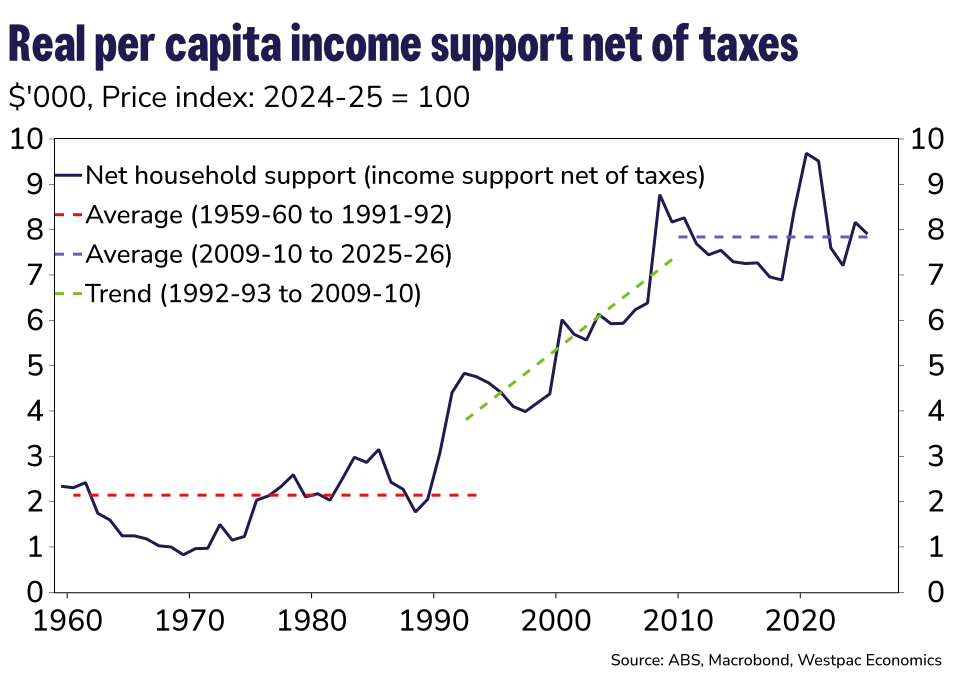
Household real (or inflation adjusted) income support net of taxes reached a record high during COVID and has remained elevated since. This average is roughly four times the levels that prevailed from the 1960s to the early 1990s, a significantly larger increase than real household incomes generally.
Where the footprint goes next will depend increasingly on services rather than infrastructure. Construction project completions should weigh on public investment, while the trajectory of programs such as the NDIS will be important in determining whether and how quickly government-supported services continue to expand.
In early February, we examined the evolution of the Australian government’s (Federal and state) economic footprint (As big as the mining boom: The rise of the public economy | Westpac IQ) using the structural relationships in the ABS 2022–23 input-output tables. We estimated that public spending generated around 35% of domestic output in 2024–25 and was linked to nearly 40% of total employment across the economy.
Record footprint, but no longer rising
Here, we update that analysis using the latest set of ABS input-output tables (2023–24) and the 2025–26 Annual National Accounts, extending the analysis by another year.
The results suggest that the government’s economic footprint has broadly held steady, generating around 35% of total domestic activity in 2025–26, around 7ppts higher than a decade ago.
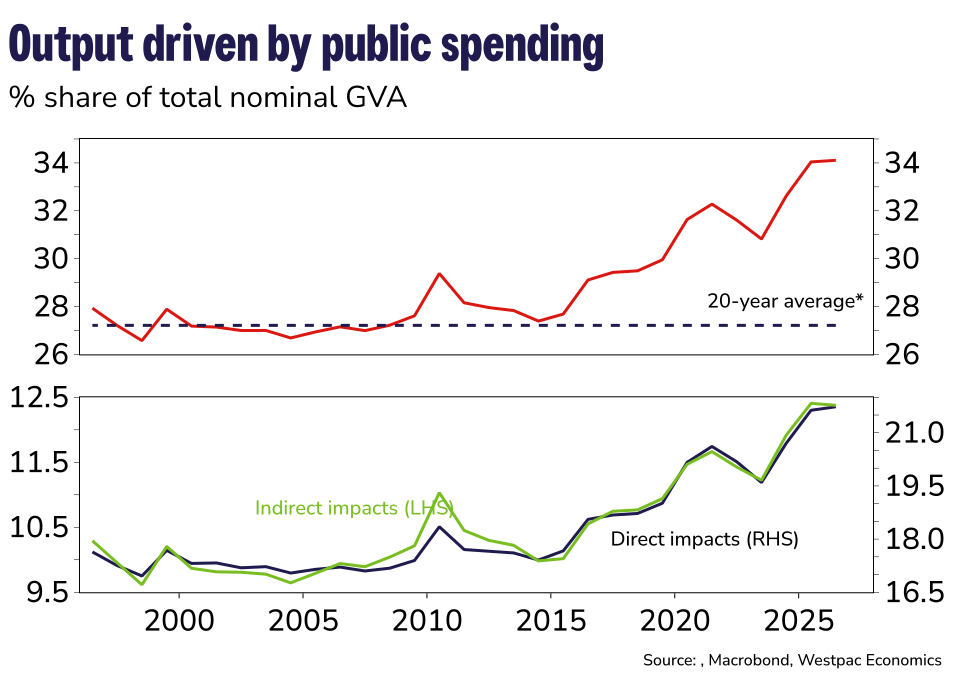
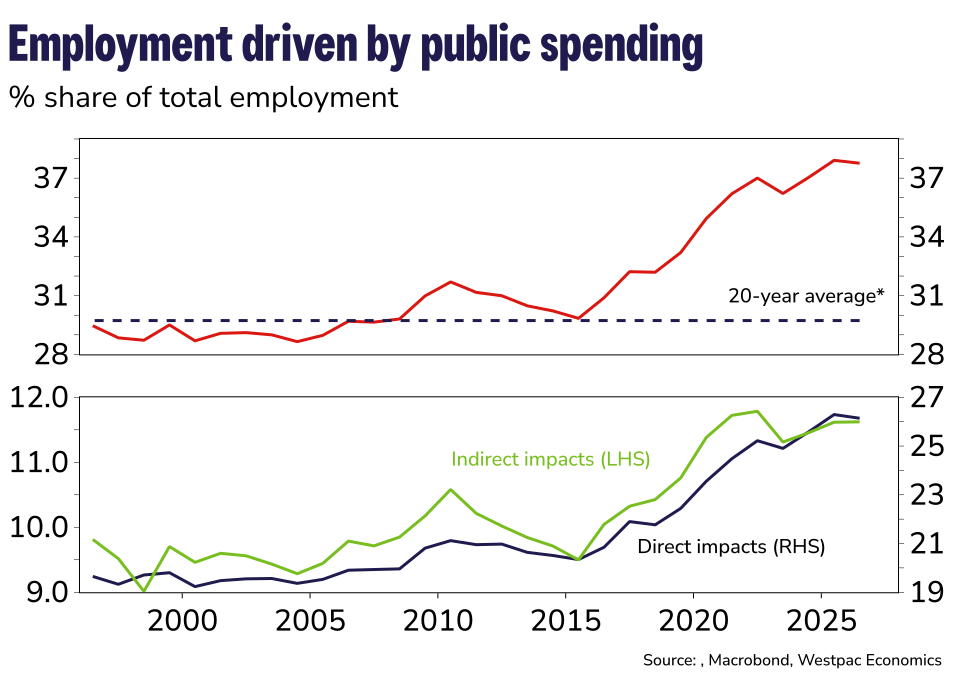
It is also linked to nearly 40% of total employment, up around 8ppts over the same period. However, the share of employment linked to public spending has edged down by around 0.5ppt of total employment. This is consistent with the slowdown in employment and hours growth we have seen across the non-market sector of the economy.
This suggests the inflationary impulse from the post-pandemic expansion in public spending is gradually fading. Importantly, the pullback is occurring in construction, where capacity pressures are likely to remain elevated as housing, data centres, renewables and commercial projects compete for resources to meet the needs of a growing population.
Infrastructure retreats as the industry mix shifts
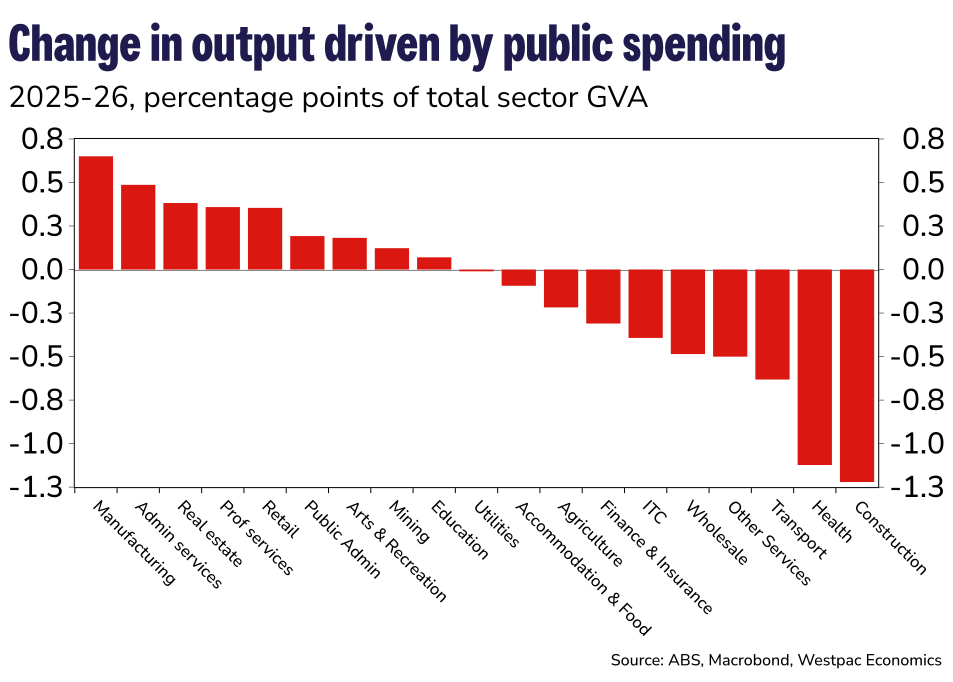
Despite this, there were important shifts beneath the aggregates. Firstly, and perhaps most importantly, the pullback in government infrastructure spending as projects complete has seen the government’s footprint in the construction industry fall by around 1.5ppts in 2025–26. We also saw significant declines across several service industries, including health care, logistics, wholesale trade and IT. This was almost fully offset by a pickup in the government’s footprint across manufacturing and several service industries, including public administration, real estate, professional services, and arts and recreation.
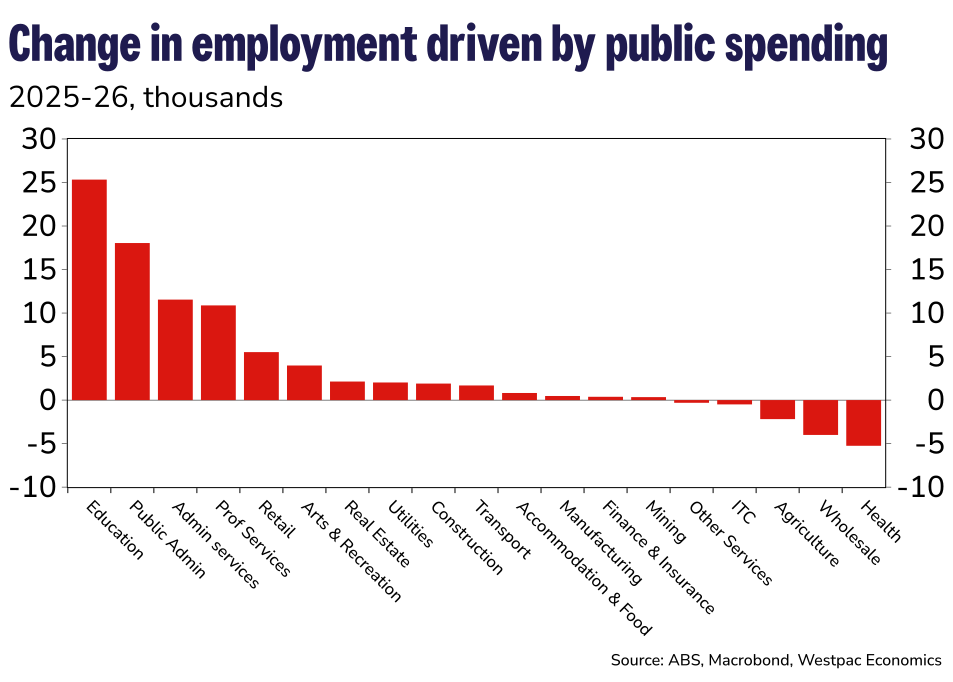
This has also shifted the number of jobs linked to government spending. Education recorded the largest increase in 2025–26, adding around 25k government-supported jobs, followed by public administration at around 18k, administrative services at 12k, and professional services at 11k. By contrast, government-supported employment fell by around 5k in health care and 4k in wholesale trade, while employment in construction was essentially flat, increasing by just 2k.
A decade of government expansion
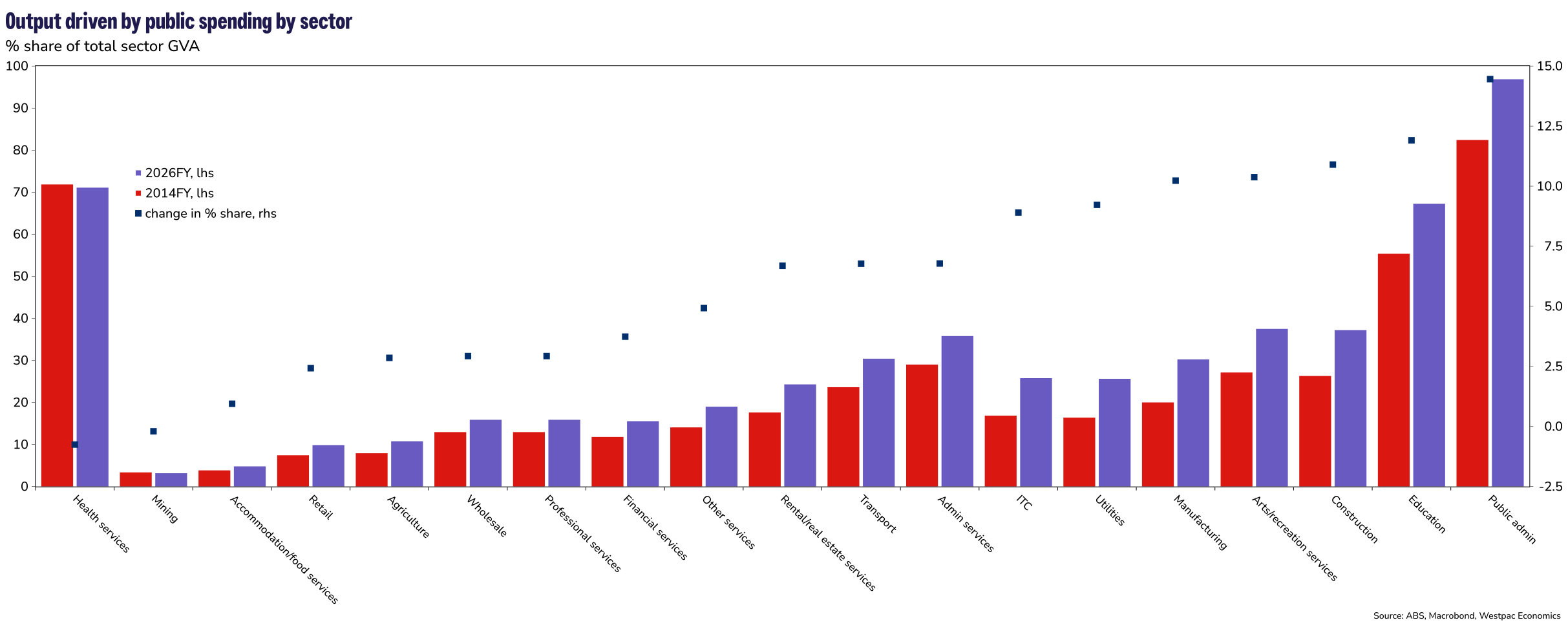
Despite these year-on-year changes, the longer-run trend remains broadly unchanged from what we reported back in February. The expansion in public spending over the past decade or so has lifted output and employment across a broad swathe of the economy, not just the non-market sector. The median public share of output across market industries (all industries excluding health care, education and public administration) has risen from around 18% in 2013–14 to 26% in 2025–26, an 8ppt lift, underscoring the scale of indirect spillovers. Indeed, the government’s footprint across most of these industries remains close to record highs.
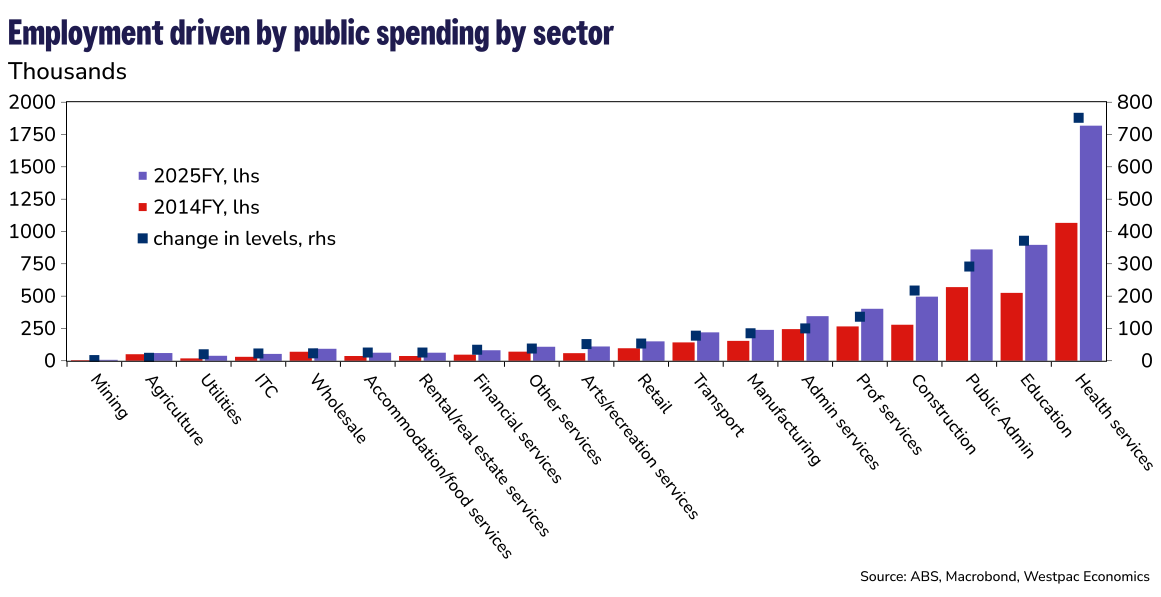
Over this period, the number of jobs supported directly and indirectly by government spending has risen by around 3.3m to 6.2m. The largest gains have been concentrated in labour-intensive services, with government-supported employment increasing by around 750k jobs in health care, 370k in education, and 292k in public administration. Construction has added around 220k jobs, while professional and administrative services have added around 136k and 100k, respectively.
A record government footprint in household incomes
While government investment and infrastructure spending have pulled back, households continue to benefit from increased spending on social services. The Annual National Accounts allow us to track this support to households, both directly through cash payments, such as unemployment benefits, and indirectly through in-kind services provided by government or government-funded market providers.
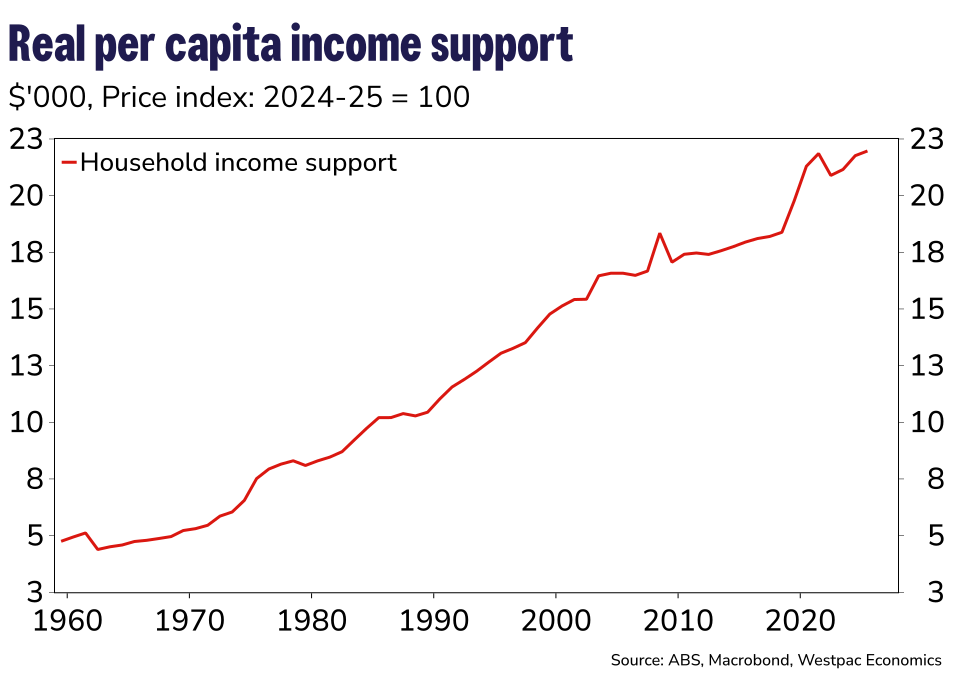
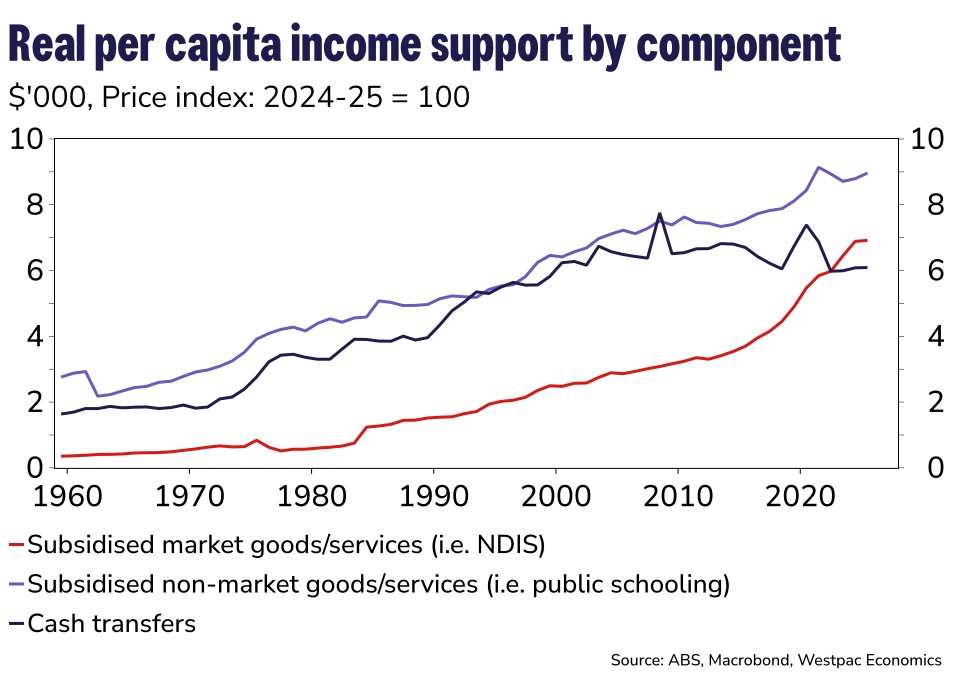
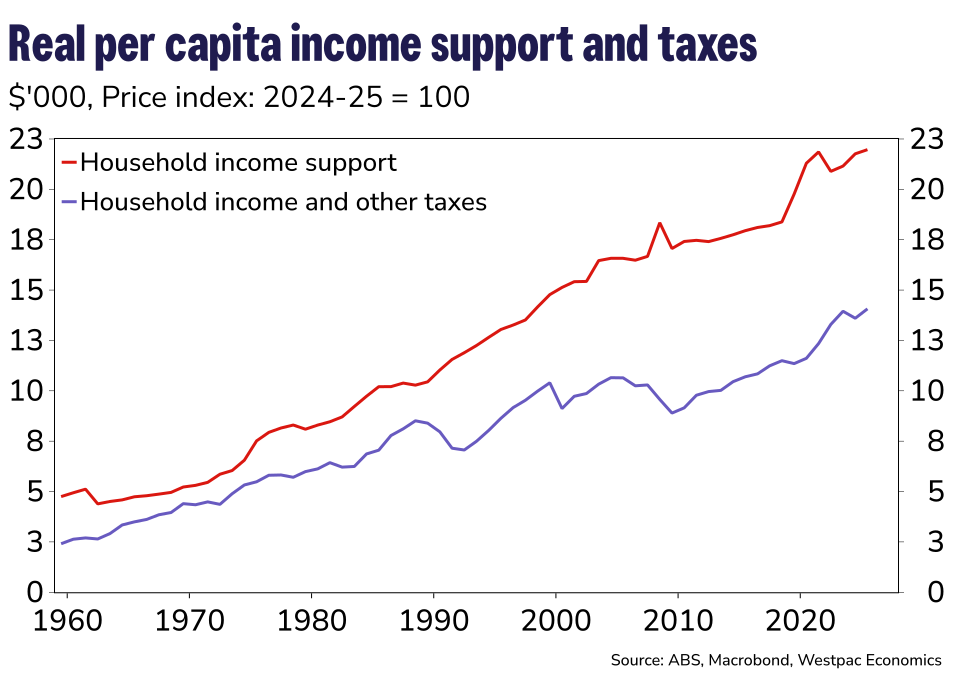
In real (or inflation adjusted) per capita terms, 2025–26 was the first year assistance surpassed pandemic-era levels, reaching $22k (in 2024-25 dollars), up from the 21.8k recorded during the pandemic.
Direct social assistance, including unemployment benefits, was broadly flat in 2025–26. However, in-kind support continued to rise strongly, particularly government-funded services delivered by market providers, including NDIS services. This support has almost doubled over the past decade, from around $3.7k to $6.9k per capita in 2024–25 dollars. By contrast, services provided directly by government, such as public schooling and public hospitals, have risen more modestly, from around $7.6k to $8.9k per capita in 2024–25 dollars.
While government income support has increased strongly, real taxes paid per capita have also risen, from around $10.7k to $14.1k over the past decade.
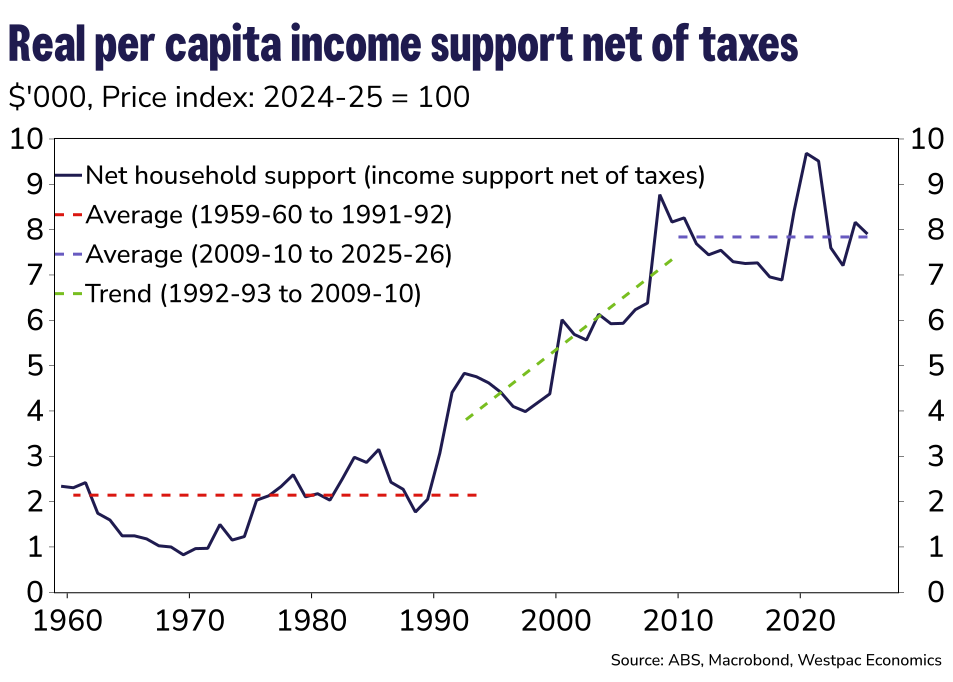
Despite rising taxes, households continue to receive around $8k per capita in net real government support, close to the record high of $9.5k during the pandemic. This represents a significant structural shift. Net support averaged around $2k per capita from the 1960s to the early 1990s, before rising sharply following the 1990s recession and stepping up again through the mining terms-of-trade and investment boom. Since 2010, it has averaged around $8k per capita, broadly where it sits today, and peaked at $9.5k during the pandemic, in 2024–25 dollars.
Put simply, real net government support per capita is now around four times the levels that prevailed from the 1960s to the early 1990s, a remarkable structural increase. By comparison, real household disposable income per capita has not quite doubled over the same period, highlighting the scale of the structural increase in net government support flowing to households.
This may help explain why reducing government spending is becoming increasingly difficult. As households become more exposed to, and reliant on, government-funded support, unwinding that support becomes both economically and politically harder. The broader fiscal lesson is clear: using temporary revenue windfalls, including mining-related tax gains, to fund permanent programs can leave the Budget under lasting structural pressure once those windfalls fade.
Bottom line
The rise of the public economy looks to be plateauing. This suggests the inflationary impulse from its rapid expansion coming out of COVID is fading, particularly as infrastructure spending retreats. But the structural shift remains firmly in place: the government’s economic footprint is still near record highs, while households are receiving around four times the real net government support that prevailed from the 1960s to the early 1990s. The next phase will therefore depend less on infrastructure and increasingly on the trajectory of government-funded services, including the NDIS.
Appendix A: Methodology overview
We estimate the economic footprint of public spending using an input–output framework that traces how public demand flows through the economy.
Detailed ABS input–output tables show how industries produce goods and services and how these outputs are used by final demand, including government consumption and investment. We focus on government-related spending—such as government final consumption and public investment—and express this demand on a consistent, domestic, basic-price basis. This ensures the analysis captures domestic value added, rather than imported content, taxes, or margins. This distinction is particularly important during periods such as the mining investment boom, when investment was import intensive and showed up in spending measures but not necessarily in domestic output.
Government spending is first allocated to the industries that directly produce the goods and services purchased by the public sector. This provides a measure of the direct impact, identifying where public demand is initially absorbed across the economy.
Industries supplying government demand also rely on inputs from other industries. To capture these supply-chain effects, we use the input–output relationships embedded in the tables to trace how government demand generates additional activity. This generates an estimate of the indirect impact, reflecting production in industries that supply inputs to those directly producing for government.
Combining these direct and indirect effects allows us to estimate the total contribution of government demand to domestic output and employment across industries.
Finally, extending the analysis over time using national accounts aggregates allows us to examine how sustained increases in public spending have altered the structure of the economy. This provides a basis for assessing how a larger and more persistent public footprint influences near-term capacity utilisation, inflation pressures, and the transmission of demand through the supply side of the economy.
Stay informed with Westpac IQ
Get the latest reports straight to your inbox.
Related articles


Browse topics
Disclaimer
©2026 Westpac Banking Corporation ABN 33 007 457 141 (including where acting under any of its Westpac, St George, Bank of Melbourne or BankSA brands, collectively, “Westpac”). References to the “Westpac Group” are to Westpac and its subsidiaries and includes the directors, employees and representatives of Westpac and its subsidiaries.
Things you should know
We respect your privacy: You can view the New Zealand Privacy Policy here, or the Australian Group Privacy Statement here. Each time someone visits our site, data is captured so that we can accurately evaluate the quality of our content and make improvements for you. We may at times use technology to capture data about you to help us to better understand you and your needs, including potentially for the purposes of assessing your individual reading habits and interests to allow us to provide suggestions regarding other reading material which may be suitable for you.
This information, unless specifically indicated otherwise, is under copyright of the Westpac Group. None of the material, nor its contents, nor any copy of it, may be altered in any way, transmitted to, copied of distributed to any other party without the prior written permission of the Westpac Group.
Disclaimer
This information has been prepared by Westpac and is intended for information purposes only. It is not intended to reflect any recommendation or financial advice and investment decisions should not be based on it. This information does not constitute an offer, a solicitation of an offer, or an inducement to subscribe for, purchase or sell any financial instrument or to enter into a legally binding contract. To the extent that this information contains any general advice, it has been prepared without taking into account your objectives, financial situation or needs and before acting on it you should consider the appropriateness of the advice. Certain types of transactions, including those involving futures, options and high yield securities give rise to substantial risk and are not suitable for all investors. We recommend that you seek your own independent legal or financial advice before proceeding with any investment decision.
This information may contain material provided by third parties. While such material is published with the necessary permission none of Westpac or its related entities accepts any responsibility for the accuracy or completeness of any such material. Although we have made every effort to ensure this information is free from error, none of Westpac or its related entities warrants the accuracy, adequacy or completeness of this information, or otherwise endorses it in any way. Except where contrary to law, Westpac Group intend by this notice to exclude liability for this information. This information is subject to change without notice and none of Westpac or its related entities is under any obligation to update this information or correct any inaccuracy which may become apparent at a later date. This information may contain or incorporate by reference forward-looking statements. The words “believe”, “anticipate”, “expect”, “intend”, “plan”, “predict”, “continue”, “assume”, “positioned”, “may”, “will”, “should”, “shall”, “risk” and other similar expressions that are predictions of or indicate future events and future trends identify forward-looking statements. These forward-looking statements include all matters that are not historical facts. Past performance is not a reliable indicator of future performance, nor are forecasts of future performance. Whilst every effort has been taken to ensure that the assumptions on which any forecasts are based are reasonable, the forecasts may be affected by incorrect assumptions or by known or unknown risks and uncertainties. The ultimate outcomes may differ substantially from any forecasts.
Conflicts of Interest: In the normal course of offering banking products and services to its clients, the Westpac Group may act in several capacities (including issuer, market maker, underwriter, distributor, swap counterparty and calculation agent) simultaneously with respect to a financial instrument, giving rise to potential conflicts of interest which may impact the performance of a financial instrument. The Westpac Group may at any time transact or hold a position (including hedging and trading positions) for its own account or the account of a client in any financial instrument which may impact the performance of that financial instrument.
Author(s) disclaimer and declaration: The author(s) confirms that (a) no part of his/her compensation was, is, or will be, directly or indirectly, related to any views or (if applicable) recommendations expressed in this material; (b) this material accurately reflects his/her personal views about the financial products, companies or issuers (if applicable) and is based on sources reasonably believed to be reliable and accurate; (c) to the best of the author’s knowledge, they are not in receipt of inside information and this material does not contain inside information; and (d) no other part of the Westpac Group has made any attempt to influence this material.
Further important information regarding sustainability-related content: This material may contain statements relating to environmental, social and governance (ESG) topics. These are subject to known and unknown risks, and there are significant uncertainties, limitations, risks and assumptions in the metrics, modelling, data, scenarios, reporting and analysis on which the statements rely. In particular, these areas are rapidly evolving and maturing, and there are variations in approaches and common standards and practice, as well as uncertainty around future related policy and legislation. Some material may include information derived from publicly available sources that have not been independently verified. No representation or warranty is made as to the accuracy, completeness or reliability of the information. There is a risk that the analysis, estimates, judgements, assumptions, views, models, scenarios or projections used may turn out to be incorrect. These risks may cause actual outcomes to differ materially from those expressed or implied. The ESG-related statements in this material do not constitute advice, nor are they guarantees or predictions of future performance, and Westpac gives no representation, warranty or assurance (including as to the quality, accuracy or completeness of the statements). You should seek your own independent advice.
Additional country disclosures:
Australia: Westpac holds an Australian Financial Services Licence (No. 233714). You can access Westpac’s Financial Services Guide here or request a copy from your Westpac point of contact. To the extent that this information contains any general advice, it has been prepared without taking into account your objectives, financial situation or needs and before acting on it you should consider the appropriateness of the advice.
New Zealand: In New Zealand, Westpac Institutional Bank refers to the brand under which products and services are provided by either Westpac (NZ division) or Westpac New Zealand Limited (company number 1763882), the New Zealand incorporated subsidiary of Westpac ("WNZL"). Any product or service made available by WNZL does not represent an offer from Westpac or any of its subsidiaries (other than WNZL). Neither Westpac nor its other subsidiaries guarantee or otherwise support the performance of WNZL in respect of any such product. WNZL is not an authorised deposit-taking institution for the purposes of Australian prudential standards. The current disclosure statements for the New Zealand branch of Westpac and WNZL can be obtained at the internet address www.westpac.co.nz.
Singapore: This material has been prepared and issued for distribution in Singapore to institutional investors, accredited investors and expert investors (as defined in the applicable Singapore laws and regulations) only. Recipients of this material in Singapore should contact Westpac Singapore Branch in respect of any matters arising from, or in connection with, this material. Westpac Singapore Branch holds a wholesale banking licence and is subject to supervision by the Monetary Authority of Singapore.
Fiji: Unless otherwise specified, the products and services for Westpac Fiji are available from www.westpac.com.fj © Westpac Banking Corporation ABN 33 007 457 141. This information does not take your personal circumstances into account and before acting on it you should consider the appropriateness of the information for your financial situation. Westpac Banking Corporation ABN 33 007 457 141 is incorporated in NSW Australia and registered as a branch in Fiji. The liability of its members is limited.
Papua New Guinea: Unless otherwise specified, the products and services for Westpac PNG are available from www.westpac.com.pg © Westpac Banking Corporation ABN 33 007 457 141. This information does not take your personal circumstances into account and before acting on it you should consider the appropriateness of the information for your financial situation. Westpac Banking Corporation ABN 33 007 457 141 is incorporated in NSW Australia. Westpac is represented in Papua New Guinea by Westpac Bank - PNG - Limited. The liability of its members is limited.
U.S.: Westpac operates in the United States of America as a federally licensed branch, regulated by the Office of the Comptroller of the Currency. Westpac is also registered with the US Commodity Futures Trading Commission (“CFTC”) as a Swap Dealer, but is neither registered as, or affiliated with, a Futures Commission Merchant registered with the US CFTC. The services and products referenced above are not insured by the Federal Deposit Insurance Corporation (“FDIC”). Westpac Capital Markets, LLC (‘WCM’), a wholly-owned subsidiary of Westpac, is a broker-dealer registered under the U.S. Securities Exchange Act of 1934 (‘the Exchange Act’) and member of the Financial Industry Regulatory Authority (‘FINRA’). In accordance with APRA's Prudential Standard 222 'Association with Related Entities', Westpac does not stand behind WCM other than as provided for in certain legal agreements between Westpac and WCM and obligations of WCM do not represent liabilities of Westpac.
This communication is provided for distribution to U.S. institutional investors in reliance on the exemption from registration provided by Rule 15a-6 under the Exchange Act and is not subject to all of the independence and disclosure standards applicable to debt research reports prepared for retail investors in the United States. WCM is the U.S. distributor of this communication and accepts responsibility for the contents of this communication. Transactions by U.S. customers of any securities referenced herein should be effected through WCM. All disclaimers set out with respect to Westpac apply equally to WCM. If you would like to speak to someone regarding any security mentioned herein, please contact WCM on +1 212 389 1269. Investing in any non-U.S. securities or related financial instruments mentioned in this communication may present certain risks. The securities of non-U.S. issuers may not be registered with, or be subject to the regulations of, the SEC in the United States. Information on such non-U.S. securities or related financial instruments may be limited. Non-U.S. companies may not be subject to audit and reporting standards and regulatory requirements comparable to those in effect in the United States. The value of any investment or income from any securities or related derivative instruments denominated in a currency other than U.S. dollars is subject to exchange rate fluctuations that may have a positive or adverse effect on the value of or income from such securities or related derivative instruments.
The author of this communication is employed by Westpac and is not registered or qualified as a research analyst, representative, or associated person of WCM or any other U.S. broker-dealer under the rules of FINRA, any other U.S. self-regulatory organisation, or the laws, rules or regulations of any State. Unless otherwise specifically stated, the views expressed herein are solely those of the author and may differ from the information, views or analysis expressed by Westpac and/or its affiliates.
UK: The London branch of Westpac is authorised in the United Kingdom by the Prudential Regulation Authority (PRA) and is subject to regulation by the Financial Conduct Authority (FCA) and limited regulation by the PRA (Financial Services Register number: 124586). The London branch of Westpac is registered at Companies House as a branch established in the United Kingdom (Branch No. BR000106). Details about the extent of the regulation of Westpac’s London branch by the PRA are available from us on request.
This communication is not being made to or distributed to, and must not be passed on to, the general public in the United Kingdom. Rather, this communication is being made only to and is directed at (a) those persons falling within the definition of Investment Professionals (set out in Article 19(5) of the Financial Services and Markets Act 2000 (Financial Promotion) Order 2005 (the “Order”)); (b) those persons falling within the definition of high net worth companies, unincorporated associations etc. (set out in Article 49(2)of the Order; (c) other persons to whom it may lawfully be communicated in accordance with the Order or (d) any persons to whom it may otherwise lawfully be made (all such persons together being referred to as “relevant persons”). Any person who is not a relevant person should not act or rely on this communication or any of its contents. In the same way, the information contained in this communication is intended for “eligible counterparties” and “professional clients” as defined by the rules of the Financial Conduct Authority and is not intended for “retail clients”. Westpac expressly prohibits you from passing on the information in this communication to any third party.
European Economic Area (“EEA”): This material may be distributed to you by either: (i) Westpac directly, or (ii) Westpac Europe GmbH (“WEG”) under a sub-licensing arrangement. WEG has not edited or otherwise modified the content of this material. WEG is authorised in Germany by the Federal Financial Supervision Authority (‘BaFin’) and subject to its regulation. WEG’s supervisory authorities are BaFin and the German Federal Bank (‘Deutsche Bundesbank’). WEG is registered with the commercial register (‘Handelsregister’) of the local court of Frankfurt am Main under registration number HRB 118483. In accordance with APRA’s Prudential Standard 222 ‘Association with Related Entities’, Westpac does not stand behind WEG other than as provided for in certain legal agreements (a risk transfer, sub-participation and collateral agreement) between Westpac and WEG and obligations of WEG do not represent liabilities of Westpac. Any product or service made available by WEG does not represent an offer from Westpac or any of its subsidiaries (other than WEG). All disclaimers set out with respect to Westpac apply equally to WEG.
This communication is not intended for distribution to, or use by any person or entity in any jurisdiction or country where such distribution or use would be contrary to local law or regulation.
This communication contains general commentary, research, and market colour. The communication does not constitute investment advice. The material may contain an ‘investment recommendation’ and/or ‘information recommending or suggesting an investment’, both as defined in Regulation (EU) No 596/2014 (including as applicable in the United Kingdom) (“MAR”). In accordance with the relevant provisions of MAR, reasonable care has been taken to ensure that the material has been objectively presented and that interests or conflicts of interest of the sender concerning the financial instruments to which that information relates have been disclosed.
Investment recommendations must be read alongside the specific disclosure which accompanies them and the general disclosure which can be found here. Such disclosure fulfils certain additional information requirements of MAR and associated delegated legislation and by accepting this communication you acknowledge that you are aware of the existence of such additional disclosure and its contents.
To the extent this communication comprises an investment recommendation it is classified as non-independent research. It has not been prepared in accordance with legal requirements designed to promote the independence of investment research and therefore constitutes a marketing communication. Further, this communication is not subject to any prohibition on dealing ahead of the dissemination of investment research.