Sustainable Finance Market Update Q1 2026
Our Q1 2026 Sustainable Finance Market Update reviews global and Australian market activity amid continued issuance moderation. This edition explores trends across sustainable bonds and loans, highlights notable transactions from the quarter and examines developments shaping the role of sustainable finance in supporting Australia’s digital infrastructure transformation. You’ll also find the latest market news and insights from across the sustainable finance landscape.

Market recap – Q1 2026
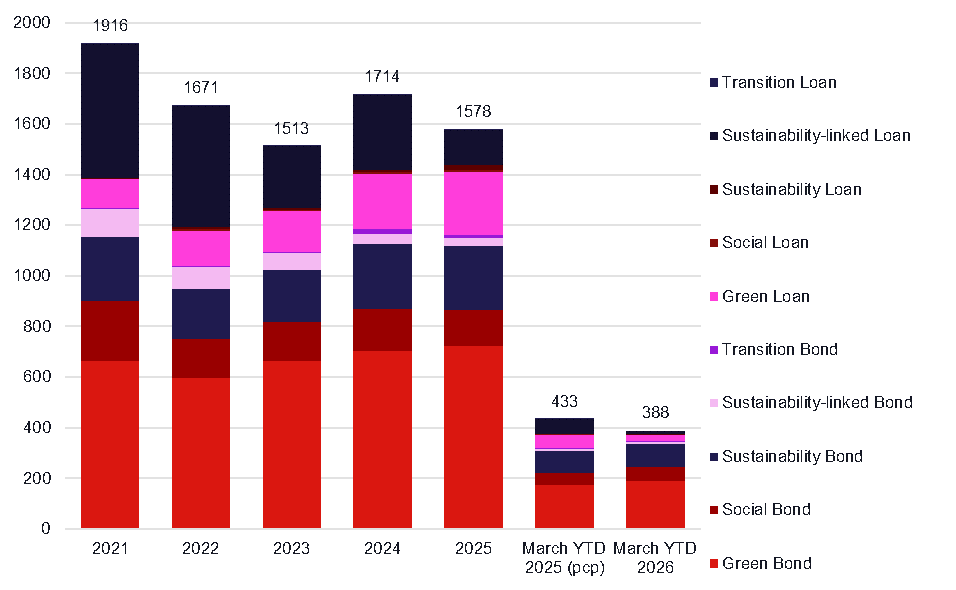
Figure 1 – Global Sustainable Finance Issuance by Year. Source: Bloomberg/Westpac
Global sustainable debt issuance totalled USD 388bn in Q1 2026, representing a 10% decline compared to the prior corresponding period and sitting below the three‑year Q1 average of approximately USD 445bn. The rolling 12‑month average fell below USD 400bn for the first time in nearly two years, highlighting the continued moderation in global labelled activity.
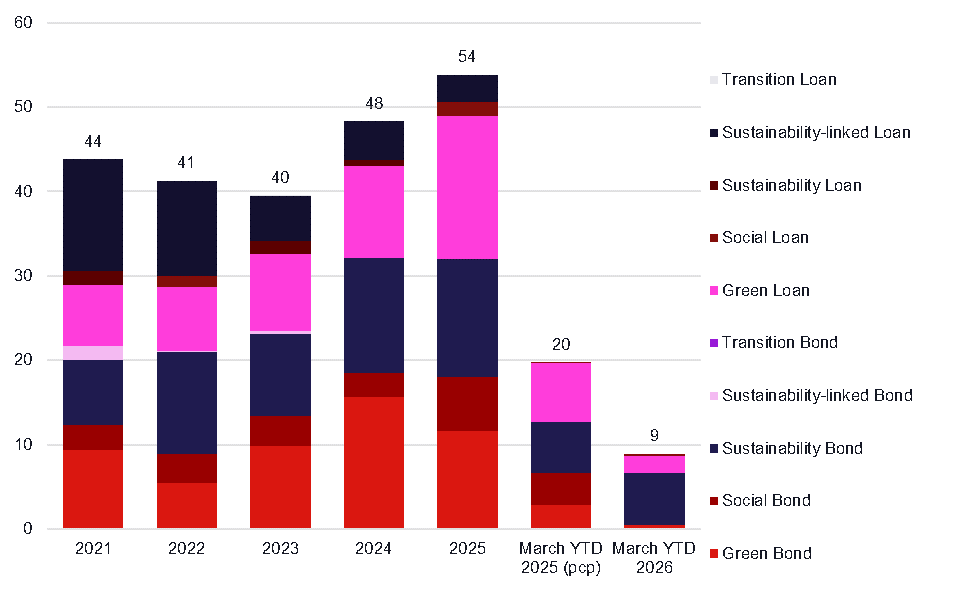
Australia also recorded softer volumes, with total sustainable debt issuance of USD 9bn in Q1, down from USD 10.1bn in the previous quarter.
Sustainable Bonds
Globally, sustainable bonds continued to dominate overall issuance, with Green Bonds remaining the largest sub‑label, recording USD 190bn in Q1.
- Sustainable Bonds represented 89% of total sustainable issuance, reflecting ongoing weakness in the Sustainable Loan market.
- Sustainability Bonds recorded their strongest ever Q1, with USD 92bn in issuance.
- While Transition Bonds have yet to be issued in Australia, global issuance has continued to build momentum, with USD 4bn issued during the quarter.
- In Australia, Green Bonds and Sustainability Bonds were the only sub‑labels issued over the period.
Sustainable Loans
The Sustainable Loan market continues to face challenges, with issuance volumes declining both globally and in Australia. Global sustainable loan issuance has fallen sharply over the past 12 months, with Q1 volumes of USD 42bn, well below the prior corresponding period (USD 115bn). Australian Sustainable Loan issuance volume was USD 2.3bn for the quarter.
- Green Loans remained the dominant sub‑label, both globally (USD 26bn) and in Australia (USD 2.1bn), accounting for the majority of labelled loan issuance.
- The Sustainability-linked loan sub-label continues to moderate, with global issuance below USD 20bn for three consecutive quarters, compared to typical quarterly volumes of USD 60–100bn during 2022–2024.
- Australia accounted for 5.5% of global sustainable loan issuance in Q1, offering a modest bright spot against an otherwise subdued market backdrop.
Notable Sustainable Finance Transactions - Q1 2026
NBN – Sustainability Bond
NBN Co Limited issued its inaugural Australian dollar Sustainability Bond in March 2026, raising AUD 850m. Priced on 12 March, the transaction represented the first Australian dollar benchmark issuance since the onset of the renewed conflict in the Middle East. Despite heightened market volatility, the deal attracted strong demand from both domestic and offshore investors, culminating in a final orderbook exceeding AUD 2.25bn. NBN’s Sustainability Bond Framework includes commitments to energy efficiency, access to essential services and socio‑economic advancement and empowerment.
Westpac acted as a Joint Lead Manager.
Mirvac – Green Bond
Mirvac printed a AUD 300m Green Bond to finance eligible green projects, assets, or activities that meet Climate Bonds Standards, in line with its existing Sustainable Financing Framework. The transaction highlighted the continued strength of high‑quality Asian demand in the domestic market, with 43% of allocations placed offshore into Asia and 80% allocated to high‑quality real money accounts.
Westpac acted as a Joint Lead Manager.
Meridian Energy - Green Bond
Meridian Energy printed AUD 400m of its inaugural Kangaroo bond in late March, attracting over AUD 1.65bn of investor demand despite a volatile market backdrop. Investor feedback was positive, with strong appetite for a new issuer in labelled format in the Australian dollar market. The transaction adopted an intraday execution approach, differing from the standard two‑day process, yet still achieved strong domestic participation which supported a faster execution. Proceeds are expected to be used to finance renewable energy and energy efficiency projects.
Westpac acted as a Joint Lead Manager and Sole Sustainability Coordinator.
Igneo Infrastructure Partners – Green Loan
In March, Igneo Infrastructure Partners (Igneo) closed its inaugural AUD 185m green tranche credit facility for the Australia New Zealand Diversified Infrastructure Fund, alongside the development of a Green Finance Framework. The Framework defines six eligible project categories: renewable energy, energy efficiency, waste management, clean transportation, sustainable water management and green buildings. Project selection is informed by market taxonomies including the Australian Sustainable Finance Taxonomy and the Climate Bonds Standard. Igneo obtained a Second Party Opinion from DNV confirming alignment with the Green Loan Principles.
Westpac acted as a Joint Sustainability Coordinator.
Aviation Capital Group – Sustainability-Linked Loan
In January 2026, Aviation Capital Group (ACG), a US‑based aircraft lessor, extended and upsized its Sustainability‑Linked Loan to USD 575m, with maturity extended to January 2029. The transaction embeds sustainability considerations into ACG’s financing strategy by linking pricing to performance against two KPIs: increasing the proportion of new‑generation aircraft in its fleet and reducing the carbon intensity of its owned aircraft portfolio. ACG manages a portfolio of over 450 aircraft, with 73% comprising new‑generation, lower‑emissions models. The facility supports fleet modernisation and ongoing investment in more fuel‑efficient aircraft.
Westpac was a lender.
Sustainable Finance News
Notable Offshore Transactions
Chile has issued a landmark EUR 1.5bn sovereign Sustainability‑Linked Bond linked to biodiversity outcomes, reinforcing its position as a pioneer in sovereign SLB markets. The bond is the first sovereign issuance aligned with biodiversity targets under the Kunming‑Montreal Global Biodiversity Framework. It includes a 25 basis point margin step‑down mechanism, tied to targets to increase the proportion of national land covered by conservation and effectively managed protected areas. The transaction highlights growing innovation in nature‑linked finance and illustrates how biodiversity considerations are becoming increasingly central within the sustainable finance market – check out last quarter’s newsletter for more on nature and sustainable finance.
Emirates NBD has completed a landmark USD 1bn dual‑tranche blue and green bond issuance under its Euro Medium Term Note Programme. The transaction comprised a USD 300mn three‑year blue bond and a USD 700mn five‑year green bond, making it the largest dual‑tranche blue‑green bond issued by a financial institution globally and the largest blue bond in the Gulf. Proceeds will be allocated in line with Emirates NBD’s Sustainable Finance Framework to support marine conservation, sustainable water management and other climate‑related initiatives.
The Asian Development Bank issued a USD 100m, 5‑year Green Bond to raise investor awareness of accelerating glacier melt and associated climate risks across Asia. The issuance is aligned with ADB’s Green and Blue Bond Framework, with proceeds allocated to projects supporting climate‑resilient infrastructure, integrated water resource management and disaster risk reduction.
ASFI releases Debt Guidance
March 2026 saw the Australian Sustainable Finance Institute release its Australian Taxonomy‑aligned Debt Guidance, supporting the application of the Australian Sustainable Finance Taxonomy (Australian Taxonomy) to use‑of‑proceeds debt instruments. Developed in collaboration with Australian Treasury, sovereign and semi‑sovereign debt managers and our very own Charlotte Plaisant Millecamps and Linh Quach, the guidance supports the interpretation and use of the Australian Taxonomy and promotes a common understanding of terms and processes for issuers, investors, coordinators and external reviewers. The guidance marks a shift from taxonomy development to practical market implementation and is intended to improve how the Australian Taxonomy can be used to support the issuance of use-of-proceeds debt.
Climate Action Week & ASFI release on Priority Actions for Financing Adaptation & Resilience
Climate Action Week 2026 was hosted in March under the theme “Change happens locally”, focusing on how locally led action can fuel global momentum. The week featured 228 events, with over 13,000 tickets sold, delivered through a diverse mix of formats catering to different levels of engagement. Notably, 60% of attendees were aged between 20 and 49, underscoring growing momentum among younger Australians for stronger action on climate goals. Speakers this year included The Hon. Chris Bowen MP and former Prime Minister Malcolm Turnbull, alongside leaders from finance, government and industry.
During the week, ASFI convened stakeholders from across the economy to explore how Australia can strengthen the financing of climate adaptation and resilience. Discussions reflected a shared understanding that climate risks are increasing, while investment in adaptation and resilience is not yet occurring at the required pace. Following the event, ASFI published an outcomes report outlining key barriers and priority areas to support greater capital allocation. A consistent message from the discussion was that the challenge is not a lack of capital, but rather the systems, structures and coordination needed to deploy it effectively.
Sustainalytics exits the SPO market
Sustainalytics has announced it will exit the Second Party Opinion (SPO) market, marking a notable development in the sustainable finance ecosystem. A long‑standing SPO provider, Sustainalytics played a key role in shaping standards and supporting integrity in labelled debt markets over more than a decade. The decision reflects challenging market dynamics with lower issuances and increasing competition for SPO services. Sustainalytics will complete existing client commitments before winding down the business, while continuing to focus on its core ESG ratings, data and research offerings.
Sustainable Finance Spotlight - Sustainable Finance and Digital Infrastructure
With Australia’s digital economy continuing to expand, so too does the infrastructure it’s built on. This infrastructure keeps us connected to friends and family, our businesses running efficiently and our essential services online. From cloud computing and e-commerce to artificial intelligence (AI), our demand for data and connectivity is accelerating and coming with it, the need for resilient and sustainable digital infrastructure. Data centres are a core part of the digital infrastructure economy and have emerged as enablers of this transformation. However, as their presence in Australia grows, so too does the imperative to ensure they operate in line with community expectations and environmental standards. Recent government announcements and the development of sustainable finance taxonomies offer a pathway to support this growth responsibly.
The post Covid-19 pandemic years have seen a sharp rise in digital activity. Internet traffic has grown by more than 20% annually since 2020, driven by the expansion of online services, remote work and AI applications. This growth has created a corresponding need for fast, reliable infrastructure that can handle a lot of use to support the digital economy.
This growth comes with scrutiny as 80% of Australian data centres are located in metropolitan areas and their visibility in communities brings with it a social license to operate. As demand increases, so too does the expectation that these facilities will be developed and operated in a way that is energy and water efficient and aligned with broader sustainability goals.
Turning to the economics, the contribution of digital infrastructure to Australia is increasingly evident. In 2025, data centre investment was a driver of business investment and GDP growth in Australia (PDF 1MB). The Clean Energy Finance Corporation (CEFC) has projected that AI, cloud computing and digital infrastructure could attract between $85–135 billion in investment over the next decade.
This presents an opportunity and one that ought to be harnessed sustainably. As the sector grows, maintaining public trust and ensuring alignment with national interests should be essential. This includes managing energy and water use, supporting grid stability and contributing to Australia’s decarbonisation goals.
Australia, with access to clean energy, is well-positioned to contribute to sustainable digital infrastructure. Data centres require energy and, for the most part, water to operate, with their efficiency typically measured by Power Use Effectiveness (PUE)1. PUE quantifies the proportion of a data centres power used directly for computing versus supporting infrastructure - the lower the PUE indicates a more energy efficient data centre. The median PUE of Australian data centres is 1.30 compared to the global average of 1.56. Unlike some international peers, Australian facilities typically avoid on-site fossil fuel combustion for their main power source, instead drawing from a grid that is decarbonising.
Government policy is also reinforcing this trajectory towards more energy efficient data centres. The Federal Government now requires all data centre services procured by the Commonwealth to meet a five-star NABERS rating (equivalent to a PUE of 1.34). New guidelines released earlier this year outline expectations for data centre and AI infrastructure developers, including prioritisation of projects that are energy and water efficient and aligned with national clean energy objectives. The Green Building Council of Australia also recently announced a Sustainable Data Centres program aimed at exploring what best practice sustainability outcomes for data centres in Australia could look like.
Alongside these Government initiatives and expectations, sustainable finance frameworks are developing screening criteria to assess data centres. The NABERS rating system and the Australian Sustainable Finance Taxonomy provide technical screening criteria to assess the environmental credentials of data centres. These tools enable issuers to credibly label their assets as ‘green’ or ‘sustainable’, helping to attract ESG-focused capital and can support investors screening and assessing new investments. Recent transactions include AirTrunk’s AUD 16bn (ex Japan) sustainable financing with a mixture of green and sustainability-linked loans tied to energy and water efficiency, renewable energy adoption and gender pay equity as well as Stack Infrastructure’s AUD 1.3bn Green Loan in 2025 for their Melbourne hyperscale campus.
Australia’s digital infrastructure sector is set for continued growth, which is good for the economy and increasingly is recognised by policymakers and market participants. But it must be delivered in a way that is conscious, efficient and aligned with the expectations of the communities these assets operate in. Sustainable finance can offer a pathway to support this. By including labels or linking investment to measurable outcomes (ie. PUE reductions, renewable energy use and water conservation), sustainable finance could help ensure that digital infrastructure development contributes positively to Australia’s net zero ambitions and maintains its social license.
1 Other measures of data centre efficiency include Water Use Effectiveness and Renewable Energy Factor (DCCEEW, 2021).
The Sustainable finance team recommends
Our Sustainable Finance team recently welcomed Kaitlin Edwards, who has joined as a Director based in Melbourne. Kaitlin returns to Australia following a number of years in the United Kingdom, where she worked on the structuring of green, social and sustainability‑linked loans for clients across Europe, the Middle East and Africa. She is keen to connect with new and existing organisations interested in sustainable finance, so if you are in Melbourne please feel free to reach out to Kaitlin for a coffee and chat!
Stay informed with Westpac IQ
Get the latest reports straight to your inbox.
Related articles

Browse topics
Disclaimer
©2026 Westpac Banking Corporation ABN 33 007 457 141 (including where acting under any of its Westpac, St George, Bank of Melbourne or BankSA brands, collectively, “Westpac”). References to the “Westpac Group” are to Westpac and its subsidiaries and includes the directors, employees and representatives of Westpac and its subsidiaries.
Things you should know
We respect your privacy: You can view the New Zealand Privacy Policy here, or the Australian Group Privacy Statement here. Each time someone visits our site, data is captured so that we can accurately evaluate the quality of our content and make improvements for you. We may at times use technology to capture data about you to help us to better understand you and your needs, including potentially for the purposes of assessing your individual reading habits and interests to allow us to provide suggestions regarding other reading material which may be suitable for you.
This information, unless specifically indicated otherwise, is under copyright of the Westpac Group. None of the material, nor its contents, nor any copy of it, may be altered in any way, transmitted to, copied of distributed to any other party without the prior written permission of the Westpac Group.
Disclaimer
This information has been prepared by Westpac and is intended for information purposes only. It is not intended to reflect any recommendation or financial advice and investment decisions should not be based on it. This information does not constitute an offer, a solicitation of an offer, or an inducement to subscribe for, purchase or sell any financial instrument or to enter into a legally binding contract. To the extent that this information contains any general advice, it has been prepared without taking into account your objectives, financial situation or needs and before acting on it you should consider the appropriateness of the advice. Certain types of transactions, including those involving futures, options and high yield securities give rise to substantial risk and are not suitable for all investors. We recommend that you seek your own independent legal or financial advice before proceeding with any investment decision.
This information may contain material provided by third parties. While such material is published with the necessary permission none of Westpac or its related entities accepts any responsibility for the accuracy or completeness of any such material. Although we have made every effort to ensure this information is free from error, none of Westpac or its related entities warrants the accuracy, adequacy or completeness of this information, or otherwise endorses it in any way. Except where contrary to law, Westpac Group intend by this notice to exclude liability for this information. This information is subject to change without notice and none of Westpac or its related entities is under any obligation to update this information or correct any inaccuracy which may become apparent at a later date. This information may contain or incorporate by reference forward-looking statements. The words “believe”, “anticipate”, “expect”, “intend”, “plan”, “predict”, “continue”, “assume”, “positioned”, “may”, “will”, “should”, “shall”, “risk” and other similar expressions that are predictions of or indicate future events and future trends identify forward-looking statements. These forward-looking statements include all matters that are not historical facts. Past performance is not a reliable indicator of future performance, nor are forecasts of future performance. Whilst every effort has been taken to ensure that the assumptions on which any forecasts are based are reasonable, the forecasts may be affected by incorrect assumptions or by known or unknown risks and uncertainties. The ultimate outcomes may differ substantially from any forecasts.
Conflicts of Interest: In the normal course of offering banking products and services to its clients, the Westpac Group may act in several capacities (including issuer, market maker, underwriter, distributor, swap counterparty and calculation agent) simultaneously with respect to a financial instrument, giving rise to potential conflicts of interest which may impact the performance of a financial instrument. The Westpac Group may at any time transact or hold a position (including hedging and trading positions) for its own account or the account of a client in any financial instrument which may impact the performance of that financial instrument.
Author(s) disclaimer and declaration: The author(s) confirms that (a) no part of his/her compensation was, is, or will be, directly or indirectly, related to any views or (if applicable) recommendations expressed in this material; (b) this material accurately reflects his/her personal views about the financial products, companies or issuers (if applicable) and is based on sources reasonably believed to be reliable and accurate; (c) to the best of the author’s knowledge, they are not in receipt of inside information and this material does not contain inside information; and (d) no other part of the Westpac Group has made any attempt to influence this material.
Further important information regarding sustainability-related content: This material may contain statements relating to environmental, social and governance (ESG) topics. These are subject to known and unknown risks, and there are significant uncertainties, limitations, risks and assumptions in the metrics, modelling, data, scenarios, reporting and analysis on which the statements rely. In particular, these areas are rapidly evolving and maturing, and there are variations in approaches and common standards and practice, as well as uncertainty around future related policy and legislation. Some material may include information derived from publicly available sources that have not been independently verified. No representation or warranty is made as to the accuracy, completeness or reliability of the information. There is a risk that the analysis, estimates, judgements, assumptions, views, models, scenarios or projections used may turn out to be incorrect. These risks may cause actual outcomes to differ materially from those expressed or implied. The ESG-related statements in this material do not constitute advice, nor are they guarantees or predictions of future performance, and Westpac gives no representation, warranty or assurance (including as to the quality, accuracy or completeness of the statements). You should seek your own independent advice.
Additional country disclosures:
Australia: Westpac holds an Australian Financial Services Licence (No. 233714). You can access Westpac’s Financial Services Guide here or request a copy from your Westpac point of contact. To the extent that this information contains any general advice, it has been prepared without taking into account your objectives, financial situation or needs and before acting on it you should consider the appropriateness of the advice.
New Zealand: In New Zealand, Westpac Institutional Bank refers to the brand under which products and services are provided by either Westpac (NZ division) or Westpac New Zealand Limited (company number 1763882), the New Zealand incorporated subsidiary of Westpac ("WNZL"). Any product or service made available by WNZL does not represent an offer from Westpac or any of its subsidiaries (other than WNZL). Neither Westpac nor its other subsidiaries guarantee or otherwise support the performance of WNZL in respect of any such product. WNZL is not an authorised deposit-taking institution for the purposes of Australian prudential standards. The current disclosure statements for the New Zealand branch of Westpac and WNZL can be obtained at the internet address www.westpac.co.nz.
Singapore: This material has been prepared and issued for distribution in Singapore to institutional investors, accredited investors and expert investors (as defined in the applicable Singapore laws and regulations) only. Recipients of this material in Singapore should contact Westpac Singapore Branch in respect of any matters arising from, or in connection with, this material. Westpac Singapore Branch holds a wholesale banking licence and is subject to supervision by the Monetary Authority of Singapore.
Fiji: Unless otherwise specified, the products and services for Westpac Fiji are available from www.westpac.com.fj © Westpac Banking Corporation ABN 33 007 457 141. This information does not take your personal circumstances into account and before acting on it you should consider the appropriateness of the information for your financial situation. Westpac Banking Corporation ABN 33 007 457 141 is incorporated in NSW Australia and registered as a branch in Fiji. The liability of its members is limited.
Papua New Guinea: Unless otherwise specified, the products and services for Westpac PNG are available from www.westpac.com.pg © Westpac Banking Corporation ABN 33 007 457 141. This information does not take your personal circumstances into account and before acting on it you should consider the appropriateness of the information for your financial situation. Westpac Banking Corporation ABN 33 007 457 141 is incorporated in NSW Australia. Westpac is represented in Papua New Guinea by Westpac Bank - PNG - Limited. The liability of its members is limited.
U.S.: Westpac operates in the United States of America as a federally licensed branch, regulated by the Office of the Comptroller of the Currency. Westpac is also registered with the US Commodity Futures Trading Commission (“CFTC”) as a Swap Dealer, but is neither registered as, or affiliated with, a Futures Commission Merchant registered with the US CFTC. The services and products referenced above are not insured by the Federal Deposit Insurance Corporation (“FDIC”). Westpac Capital Markets, LLC (‘WCM’), a wholly-owned subsidiary of Westpac, is a broker-dealer registered under the U.S. Securities Exchange Act of 1934 (‘the Exchange Act’) and member of the Financial Industry Regulatory Authority (‘FINRA’). In accordance with APRA's Prudential Standard 222 'Association with Related Entities', Westpac does not stand behind WCM other than as provided for in certain legal agreements between Westpac and WCM and obligations of WCM do not represent liabilities of Westpac.
This communication is provided for distribution to U.S. institutional investors in reliance on the exemption from registration provided by Rule 15a-6 under the Exchange Act and is not subject to all of the independence and disclosure standards applicable to debt research reports prepared for retail investors in the United States. WCM is the U.S. distributor of this communication and accepts responsibility for the contents of this communication. Transactions by U.S. customers of any securities referenced herein should be effected through WCM. All disclaimers set out with respect to Westpac apply equally to WCM. If you would like to speak to someone regarding any security mentioned herein, please contact WCM on +1 212 389 1269. Investing in any non-U.S. securities or related financial instruments mentioned in this communication may present certain risks. The securities of non-U.S. issuers may not be registered with, or be subject to the regulations of, the SEC in the United States. Information on such non-U.S. securities or related financial instruments may be limited. Non-U.S. companies may not be subject to audit and reporting standards and regulatory requirements comparable to those in effect in the United States. The value of any investment or income from any securities or related derivative instruments denominated in a currency other than U.S. dollars is subject to exchange rate fluctuations that may have a positive or adverse effect on the value of or income from such securities or related derivative instruments.
The author of this communication is employed by Westpac and is not registered or qualified as a research analyst, representative, or associated person of WCM or any other U.S. broker-dealer under the rules of FINRA, any other U.S. self-regulatory organisation, or the laws, rules or regulations of any State. Unless otherwise specifically stated, the views expressed herein are solely those of the author and may differ from the information, views or analysis expressed by Westpac and/or its affiliates.
UK: The London branch of Westpac is authorised in the United Kingdom by the Prudential Regulation Authority (PRA) and is subject to regulation by the Financial Conduct Authority (FCA) and limited regulation by the PRA (Financial Services Register number: 124586). The London branch of Westpac is registered at Companies House as a branch established in the United Kingdom (Branch No. BR000106). Details about the extent of the regulation of Westpac’s London branch by the PRA are available from us on request.
This communication is not being made to or distributed to, and must not be passed on to, the general public in the United Kingdom. Rather, this communication is being made only to and is directed at (a) those persons falling within the definition of Investment Professionals (set out in Article 19(5) of the Financial Services and Markets Act 2000 (Financial Promotion) Order 2005 (the “Order”)); (b) those persons falling within the definition of high net worth companies, unincorporated associations etc. (set out in Article 49(2)of the Order; (c) other persons to whom it may lawfully be communicated in accordance with the Order or (d) any persons to whom it may otherwise lawfully be made (all such persons together being referred to as “relevant persons”). Any person who is not a relevant person should not act or rely on this communication or any of its contents. In the same way, the information contained in this communication is intended for “eligible counterparties” and “professional clients” as defined by the rules of the Financial Conduct Authority and is not intended for “retail clients”. Westpac expressly prohibits you from passing on the information in this communication to any third party.
European Economic Area (“EEA”): This material may be distributed to you by either: (i) Westpac directly, or (ii) Westpac Europe GmbH (“WEG”) under a sub-licensing arrangement. WEG has not edited or otherwise modified the content of this material. WEG is authorised in Germany by the Federal Financial Supervision Authority (‘BaFin’) and subject to its regulation. WEG’s supervisory authorities are BaFin and the German Federal Bank (‘Deutsche Bundesbank’). WEG is registered with the commercial register (‘Handelsregister’) of the local court of Frankfurt am Main under registration number HRB 118483. In accordance with APRA’s Prudential Standard 222 ‘Association with Related Entities’, Westpac does not stand behind WEG other than as provided for in certain legal agreements (a risk transfer, sub-participation and collateral agreement) between Westpac and WEG and obligations of WEG do not represent liabilities of Westpac. Any product or service made available by WEG does not represent an offer from Westpac or any of its subsidiaries (other than WEG). All disclaimers set out with respect to Westpac apply equally to WEG.
This communication is not intended for distribution to, or use by any person or entity in any jurisdiction or country where such distribution or use would be contrary to local law or regulation.
This communication contains general commentary, research, and market colour. The communication does not constitute investment advice. The material may contain an ‘investment recommendation’ and/or ‘information recommending or suggesting an investment’, both as defined in Regulation (EU) No 596/2014 (including as applicable in the United Kingdom) (“MAR”). In accordance with the relevant provisions of MAR, reasonable care has been taken to ensure that the material has been objectively presented and that interests or conflicts of interest of the sender concerning the financial instruments to which that information relates have been disclosed.
Investment recommendations must be read alongside the specific disclosure which accompanies them and the general disclosure which can be found here. Such disclosure fulfils certain additional information requirements of MAR and associated delegated legislation and by accepting this communication you acknowledge that you are aware of the existence of such additional disclosure and its contents.
To the extent this communication comprises an investment recommendation it is classified as non-independent research. It has not been prepared in accordance with legal requirements designed to promote the independence of investment research and therefore constitutes a marketing communication. Further, this communication is not subject to any prohibition on dealing ahead of the dissemination of investment research.