Weekly Economic Commentary
Welcome to 2026. In our first update for this year, we take a look at how the outlooks for monetary and fiscal policy are shaping up. We also look at the state of economic activity and the housing market, and preview key upcoming data.

Brand new year, new challenges.
As the year gets underway, the New Zealand economy feels like it’s at a turning point. There’s been a significant easing in monetary policy over the past year, the full impact of which is yet to be felt. As lower interest rates work their way through the economy, we expect to see economic conditions and the labour market gradually firming. In fact, we’ve already started to see spending picking up.
However, for now the economy is still dealing with some important challenges. Most notably, unemployment remains elevated and the cost of living is continuing to squeeze households. At the same time, the housing market has remained flat, and that’s likely to remain the case at least in the near term.
2026 is also likely to see a shift in the relative performance of regions across New Zealand. Over the past year, firm commodity prices and stronger conditions in our rural regions underpinned growth. This year growth is likely to be more broad-based, with lower interest rates likely to support activity across the nation.
RBNZ Governor seeks to calm markets
Last year we saw the likely end of the RBNZ’s easing cycle, with the market’s attention swiftly turning to the timing of possible hikes. The pulling forward of rate hike expectations saw RBNZ Governor Breman taking the rare step of commenting on monetary conditions outside of the usual window that follows a Monetary Policy Statement (MPS) or Review.
Governor Breman emphasized that financial conditions have tightened relative to the assumptions embedded in the November MPS forecasts, and that there is still a lot of water to go under the bridge before OCR increases come into view. It seems clear that the RBNZ was not seeking a significant tightening in financial conditions and is now sending the signal that market pricing of OCR increases had run significantly ahead of the data and RBNZ thinking. Indeed, in one interview she noted “…given that we see inflation also falling and being low and stable going forward, it's very important now that we see growth that's lasting, that we see that we have a period where growth is coming back.”
In the wake of the Governor’s comments, market pricing shifted out again, with markets now expecting just one hike this year. We remain comfortable with our longstanding forecast of a single hike in 2026 (which we’ve pencilled in for the December meeting, after the General Election), with gradual hikes after that time.
These comments from the Governor are a welcome move, and hopefully we see further such comments in between policy statements from the RBNZ. The Governor noted that there is support amongst the MPC for introducing increased transparency around individual MPC member’s views and adding an additional (likely January) meeting into the calendar. However, with RBNZ policy meeting dates already announced through to February 2027, any change in the frequency of RBNZ meetings is still a way off.
Fiscal policy: Less debt now, more debt later
Just before the close of last year, Treasury released the Half Year Economic and Fiscal Update (HYEFU). The local bond market welcomed the HYEFU, with this year’s bond programme unexpectedly revised down by $3bn to $35bn and next year’s programme revised down by $2bn to $34bn. However, the entirety of that revision was driven by a decision to reduce the Crown’s minimum liquidity buffer by $5bn to $10bn (phased in over two years). As we discussed in our review, the underlying fiscal outlook portrayed by the Treasury was in fact slightly weaker than we had expected. This was reflected in the further delay of the projected return to surplus (now 2029/30 on the Government’s favoured OBEGALx measure) and a $4bn upward revision to the projected bond programme in both 2027/28 and 2028/29.
It is worth noting that the Treasury’s forecasts were finalised back in late October, prior to the more recent run of more positive economic indicators (culminating in last month’s GDP report). However, these forecasts were also finalised prior to the recent marked easing of dairy prices (discussed further below). We also note that the Treasury’s forecasts for financing costs are based on what we would consider to be optimistic forecasts for interest rates, with the OCR forecast to remain below 3% throughout the forecast period and the 10-year bond rate around the 4% level. Absent a much stronger cyclical upswing in the economy than we currently expect, the balance of risks remains skewed towards more bond issuance than depicted in the HYEFU.
September quarter GDP rebound
On the activity front, the September quarter saw a rebound in economic growth. As we set out in some detail in a post-release chart pack, GDP grew by 1.1% over the quarter, ahead of our 0.9% pick and at the top of the range of market forecasts (0.6% to 1.1%). Growth for the quarter was broad-based, with gains in all but two industries. Revisions to previous quarters meant that the annual growth rate landed in line with our forecast of +1.3%. This was the first year-on-year increase since June 2024.
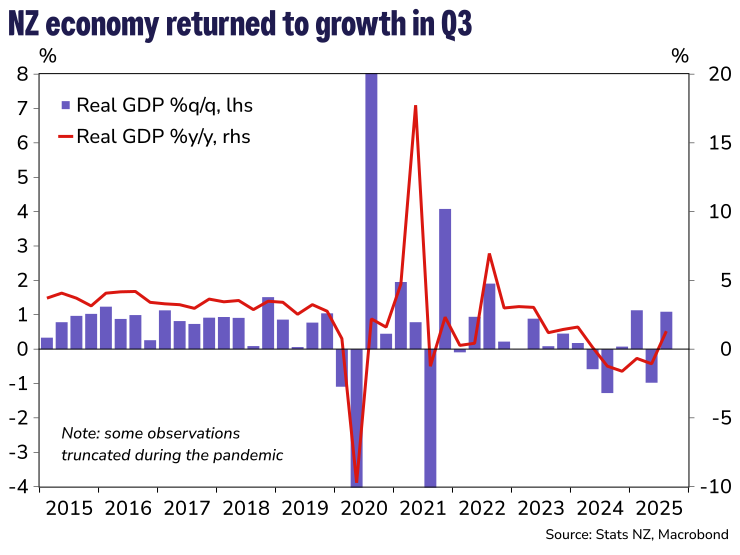
We expect further solid growth in the coming quarters, albeit with some lingering seasonality in the reported data. We are forecasting 1.7% growth for 2025 and 3.0% over 2026.
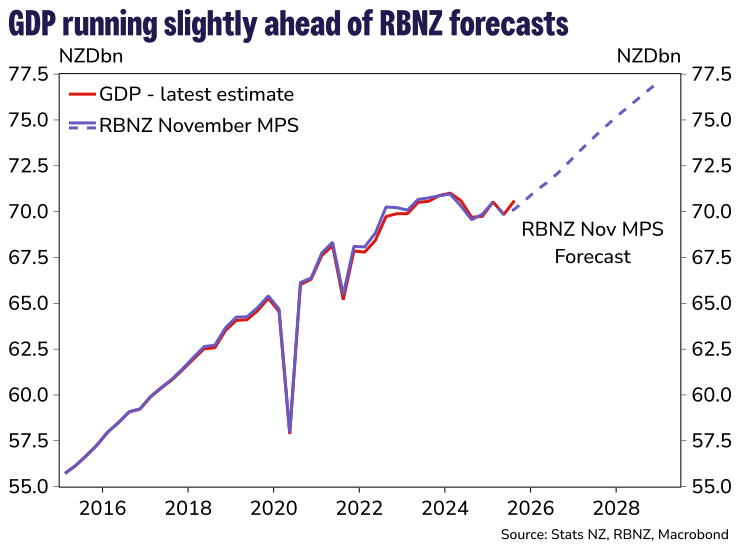
Overall, the GDP figures represent an upside surprise to the RBNZ’s forecasts and imply less spare capacity in the economy than they had anticipated. The RBNZ had previously signalled some small chance of another OCR cut. But with GDP ahead of their forecasts and other signs that economic activity is firming, the chance of another OCR cut in the near term looks remote.
December quarter CPI tracking firmer
On the prices front, Stats NZ’s November update was a bit firmer than we expected. That surprise was due to the volatile travel categories, and means the risks to our forecast for a 0.3% quarterly rise in the overall CPI (out 23 January) are tilted to the upside.
Our existing forecast is already higher than the RBNZ’s November MPS forecast for a 0.2% rise. We expect both tradables and non-tradables inflation will be a bit hotter than the RBNZ expects in the December quarter, with tradable prices accounting for most of that difference. We’ll finalise our forecast after Stats NZ releases its monthly price update for December this Friday.
Looking to 2026, our forecasts remain for a gradual easing in inflation from its current level of 3% in the year to September, and we expect inflation will be comfortably inside the RBNZ’s target band by mid-2026. A key reason for that is the continued softness in housing related costs. Housing rents, which are the largest component of the CPI, have recorded very low increases in recent months, with annual rental inflation slowing to its lowest levels since 2010. And with continued increases in housing supply and low population growth, we expect rental growth will remain subdued for some time. Similarly, construction cost inflation has slowed sharply over the past year, and it is likely to remain muted in the early part of 2026.
The housing market ended 2025 with limited momentum
Turning to the housing market, it was a soft end to the year. Sales fell 3% in November, and prices were down 0.3% (adjusting for normal seasonal variations).
Smoothing through the usual month-to-month swings, the broader picture in New Zealand’s housing market is one of limited momentum. Sales have been tracking sideways. And while we’re seeing mixed trends in prices around the country, the overall picture has been flat since mid-2023.
This continued softness is especially notable given the large falls in interest rates over the past year. However, those interest rate falls have occurred at the same time as we’ve seen a large increase in the number of properties for sale. In fact, adjusting for normal seasonal trends, the number of homes available for sale is at its highest level in a decade.
Looking ahead, with the RBNZ signalling that the rate cutting cycle has likely come to a close, we’re expecting only modest house price growth over the year ahead. And at this stage, the risks appear tilted towards continued softness in the housing market, at least in the early part of the year.
Global dairy prices under downward pressure
Finally, after a string of declines late last year, the first GlobalDairyTrade (GDT) auction for 2026 saw a sharp rise in dairy product prices, with the overall GDT index rising 6.3%. That was led by a 7.2% rise in the price of whole milk powder – the most important commodity in the New Zealand export basket.
Late last year, Fonterra reduced its estimated milk payout by a further 50c to $9.00/kgMS (with a range of $8.50-$9.50). As an approximation, each 50c reduction in the payout equates to around a $1bn reduction in export revenue (just over 0.2% of GDP). While Fonterra’s revised forecast is below our current forecast of $9.30/kg, the rebound in the early January auction limits the downside risks. We’ll wait to see how dairy prices evolve before considering whether any revision to our forecast is necessary.
The week ahead
Locally, the highlight of this week’s data calendar will be the NZIER’s Quarterly Survey of Business Opinion (out Tuesday). This will be closely watched by the RBNZ to gauge how the economy and inflation are tracking at the start of the new year. Late in the week, Stats NZ will release its December prices update, which will be a key input into next week’s December quarter CPI.
Offshore, Australia has updates on household spending (Monday), consumer confidence (Tuesday) and inflation expectations (Thursday). In the US, December’s CPI report is out Tuesday, with the retail sales report out on Friday. There will also be several Fed speakers throughout the week.
Q4 NZIER QSBO
Jan 13: General business confidence - last: +15
The QSBO will be closely watched by the RBNZ ahead of their February policy meeting. The last update pointed to soft but improving trading conditions, with businesses expecting a firming in activity over the coming months. We’ll be watching to see if the December quarter survey reinforces the picture of strengthening economic momentum in recent months. The measures of price pressures will also be closely watched, with recent surveys pointing to ongoing cost pressures, but limited ability to raise output prices.
Q4 Westpac-McDermott Miller Employment Confidence
Jan 14: Last: 89.9
Despite nudging higher in our last survey, confidence in New Zealand’s job market remained low through the middle part of the year. A perceived lack of job opportunities and low job security continue to be key concerns for New Zealanders. Since our last survey, economic activity has started to firm, but monthly jobs figures have remained subdued. The latest survey was conducted on 1-11 December.
Nov Building Consents
Jan 14, last +7.2%, Westpac f/c: -5.0%
We’re forecasting another modest easing in building consents in November after a large number of medium density projects were approved in the past couple of months (medium density projects are often approved in batches and can be ‘lumpy’ on a month-to-month basis). But more important than such monthly swings, the total number of homes consented over the past 12 months has been steadily climbing in recent months. We expect that trend will continue in the new year, pointing to a gradual rise in residential construction over 2026. On the non-residential front, commercial consents have been tracking sideways with businesses still cautious about significant capital expenditure at this stage.
Dec Selected Prices
Jan 16
Stats NZ Selected Prices provides monthly updates on around half of the quarterly CPI (out 23 January). Recent updates have pointed to some upside risk to our forecast for a 0.3% rise in the quarterly CPI. That’s mainly due to gains in the travel-related categories, and we’ll be watching how those track over the summer. In terms of the other big components, food prices are expected to be flat, with falls in meat prices offsetting a seasonal rise in fresh produce. We’ll also be keeping a close eye on rents, which are the largest component of the CPI. Rental growth has slowed sharply over the past year, dropping to its lowest levels since 2010. We’re forecasting that softness will continue into the new year.
Media contacts
Satish Ranchhod, Senior Economist
+64 9 336 5668 +64 21 710 852
Michael Gordon, Senior Economist
+64 9 336 5670 +64 21 749 506
Stay informed with Westpac IQ
Get the latest reports straight to your inbox.
Related articles
Weekly Economic Commentary 13 April 2026
Weekly Economic Commentary 7 April 2026
Browse topics
Disclaimer
©2026 Westpac Banking Corporation ABN 33 007 457 141 (including where acting under any of its Westpac, St George, Bank of Melbourne or BankSA brands, collectively, “Westpac”). References to the “Westpac Group” are to Westpac and its subsidiaries and includes the directors, employees and representatives of Westpac and its subsidiaries.
Things you should know
We respect your privacy: You can view the New Zealand Privacy Policy here, or the Australian Group Privacy Statement here. Each time someone visits our site, data is captured so that we can accurately evaluate the quality of our content and make improvements for you. We may at times use technology to capture data about you to help us to better understand you and your needs, including potentially for the purposes of assessing your individual reading habits and interests to allow us to provide suggestions regarding other reading material which may be suitable for you.
This information, unless specifically indicated otherwise, is under copyright of the Westpac Group. None of the material, nor its contents, nor any copy of it, may be altered in any way, transmitted to, copied of distributed to any other party without the prior written permission of the Westpac Group.
Disclaimer
This information has been prepared by Westpac and is intended for information purposes only. It is not intended to reflect any recommendation or financial advice and investment decisions should not be based on it. This information does not constitute an offer, a solicitation of an offer, or an inducement to subscribe for, purchase or sell any financial instrument or to enter into a legally binding contract. To the extent that this information contains any general advice, it has been prepared without taking into account your objectives, financial situation or needs and before acting on it you should consider the appropriateness of the advice. Certain types of transactions, including those involving futures, options and high yield securities give rise to substantial risk and are not suitable for all investors. We recommend that you seek your own independent legal or financial advice before proceeding with any investment decision.
This information may contain material provided by third parties. While such material is published with the necessary permission none of Westpac or its related entities accepts any responsibility for the accuracy or completeness of any such material. Although we have made every effort to ensure this information is free from error, none of Westpac or its related entities warrants the accuracy, adequacy or completeness of this information, or otherwise endorses it in any way. Except where contrary to law, Westpac Group intend by this notice to exclude liability for this information. This information is subject to change without notice and none of Westpac or its related entities is under any obligation to update this information or correct any inaccuracy which may become apparent at a later date. This information may contain or incorporate by reference forward-looking statements. The words “believe”, “anticipate”, “expect”, “intend”, “plan”, “predict”, “continue”, “assume”, “positioned”, “may”, “will”, “should”, “shall”, “risk” and other similar expressions that are predictions of or indicate future events and future trends identify forward-looking statements. These forward-looking statements include all matters that are not historical facts. Past performance is not a reliable indicator of future performance, nor are forecasts of future performance. Whilst every effort has been taken to ensure that the assumptions on which any forecasts are based are reasonable, the forecasts may be affected by incorrect assumptions or by known or unknown risks and uncertainties. The ultimate outcomes may differ substantially from any forecasts.
Conflicts of Interest: In the normal course of offering banking products and services to its clients, the Westpac Group may act in several capacities (including issuer, market maker, underwriter, distributor, swap counterparty and calculation agent) simultaneously with respect to a financial instrument, giving rise to potential conflicts of interest which may impact the performance of a financial instrument. The Westpac Group may at any time transact or hold a position (including hedging and trading positions) for its own account or the account of a client in any financial instrument which may impact the performance of that financial instrument.
Author(s) disclaimer and declaration: The author(s) confirms that (a) no part of his/her compensation was, is, or will be, directly or indirectly, related to any views or (if applicable) recommendations expressed in this material; (b) this material accurately reflects his/her personal views about the financial products, companies or issuers (if applicable) and is based on sources reasonably believed to be reliable and accurate; (c) to the best of the author’s knowledge, they are not in receipt of inside information and this material does not contain inside information; and (d) no other part of the Westpac Group has made any attempt to influence this material.
Further important information regarding sustainability-related content: This material may contain statements relating to environmental, social and governance (ESG) topics. These are subject to known and unknown risks, and there are significant uncertainties, limitations, risks and assumptions in the metrics, modelling, data, scenarios, reporting and analysis on which the statements rely. In particular, these areas are rapidly evolving and maturing, and there are variations in approaches and common standards and practice, as well as uncertainty around future related policy and legislation. Some material may include information derived from publicly available sources that have not been independently verified. No representation or warranty is made as to the accuracy, completeness or reliability of the information. There is a risk that the analysis, estimates, judgements, assumptions, views, models, scenarios or projections used may turn out to be incorrect. These risks may cause actual outcomes to differ materially from those expressed or implied. The ESG-related statements in this material do not constitute advice, nor are they guarantees or predictions of future performance, and Westpac gives no representation, warranty or assurance (including as to the quality, accuracy or completeness of the statements). You should seek your own independent advice.
Additional country disclosures:
Australia: Westpac holds an Australian Financial Services Licence (No. 233714). You can access Westpac’s Financial Services Guide here or request a copy from your Westpac point of contact. To the extent that this information contains any general advice, it has been prepared without taking into account your objectives, financial situation or needs and before acting on it you should consider the appropriateness of the advice.
New Zealand: In New Zealand, Westpac Institutional Bank refers to the brand under which products and services are provided by either Westpac (NZ division) or Westpac New Zealand Limited (company number 1763882), the New Zealand incorporated subsidiary of Westpac ("WNZL"). Any product or service made available by WNZL does not represent an offer from Westpac or any of its subsidiaries (other than WNZL). Neither Westpac nor its other subsidiaries guarantee or otherwise support the performance of WNZL in respect of any such product. WNZL is not an authorised deposit-taking institution for the purposes of Australian prudential standards. The current disclosure statements for the New Zealand branch of Westpac and WNZL can be obtained at the internet address www.westpac.co.nz.
Singapore: This material has been prepared and issued for distribution in Singapore to institutional investors, accredited investors and expert investors (as defined in the applicable Singapore laws and regulations) only. Recipients of this material in Singapore should contact Westpac Singapore Branch in respect of any matters arising from, or in connection with, this material. Westpac Singapore Branch holds a wholesale banking licence and is subject to supervision by the Monetary Authority of Singapore.
Fiji: Unless otherwise specified, the products and services for Westpac Fiji are available from www.westpac.com.fj © Westpac Banking Corporation ABN 33 007 457 141. This information does not take your personal circumstances into account and before acting on it you should consider the appropriateness of the information for your financial situation. Westpac Banking Corporation ABN 33 007 457 141 is incorporated in NSW Australia and registered as a branch in Fiji. The liability of its members is limited.
Papua New Guinea: Unless otherwise specified, the products and services for Westpac PNG are available from www.westpac.com.pg © Westpac Banking Corporation ABN 33 007 457 141. This information does not take your personal circumstances into account and before acting on it you should consider the appropriateness of the information for your financial situation. Westpac Banking Corporation ABN 33 007 457 141 is incorporated in NSW Australia. Westpac is represented in Papua New Guinea by Westpac Bank - PNG - Limited. The liability of its members is limited.
U.S.: Westpac operates in the United States of America as a federally licensed branch, regulated by the Office of the Comptroller of the Currency. Westpac is also registered with the US Commodity Futures Trading Commission (“CFTC”) as a Swap Dealer, but is neither registered as, or affiliated with, a Futures Commission Merchant registered with the US CFTC. The services and products referenced above are not insured by the Federal Deposit Insurance Corporation (“FDIC”). Westpac Capital Markets, LLC (‘WCM’), a wholly-owned subsidiary of Westpac, is a broker-dealer registered under the U.S. Securities Exchange Act of 1934 (‘the Exchange Act’) and member of the Financial Industry Regulatory Authority (‘FINRA’). In accordance with APRA's Prudential Standard 222 'Association with Related Entities', Westpac does not stand behind WCM other than as provided for in certain legal agreements between Westpac and WCM and obligations of WCM do not represent liabilities of Westpac.
This communication is provided for distribution to U.S. institutional investors in reliance on the exemption from registration provided by Rule 15a-6 under the Exchange Act and is not subject to all of the independence and disclosure standards applicable to debt research reports prepared for retail investors in the United States. WCM is the U.S. distributor of this communication and accepts responsibility for the contents of this communication. Transactions by U.S. customers of any securities referenced herein should be effected through WCM. All disclaimers set out with respect to Westpac apply equally to WCM. If you would like to speak to someone regarding any security mentioned herein, please contact WCM on +1 212 389 1269. Investing in any non-U.S. securities or related financial instruments mentioned in this communication may present certain risks. The securities of non-U.S. issuers may not be registered with, or be subject to the regulations of, the SEC in the United States. Information on such non-U.S. securities or related financial instruments may be limited. Non-U.S. companies may not be subject to audit and reporting standards and regulatory requirements comparable to those in effect in the United States. The value of any investment or income from any securities or related derivative instruments denominated in a currency other than U.S. dollars is subject to exchange rate fluctuations that may have a positive or adverse effect on the value of or income from such securities or related derivative instruments.
The author of this communication is employed by Westpac and is not registered or qualified as a research analyst, representative, or associated person of WCM or any other U.S. broker-dealer under the rules of FINRA, any other U.S. self-regulatory organisation, or the laws, rules or regulations of any State. Unless otherwise specifically stated, the views expressed herein are solely those of the author and may differ from the information, views or analysis expressed by Westpac and/or its affiliates.
UK: The London branch of Westpac is authorised in the United Kingdom by the Prudential Regulation Authority (PRA) and is subject to regulation by the Financial Conduct Authority (FCA) and limited regulation by the PRA (Financial Services Register number: 124586). The London branch of Westpac is registered at Companies House as a branch established in the United Kingdom (Branch No. BR000106). Details about the extent of the regulation of Westpac’s London branch by the PRA are available from us on request.
This communication is not being made to or distributed to, and must not be passed on to, the general public in the United Kingdom. Rather, this communication is being made only to and is directed at (a) those persons falling within the definition of Investment Professionals (set out in Article 19(5) of the Financial Services and Markets Act 2000 (Financial Promotion) Order 2005 (the “Order”)); (b) those persons falling within the definition of high net worth companies, unincorporated associations etc. (set out in Article 49(2)of the Order; (c) other persons to whom it may lawfully be communicated in accordance with the Order or (d) any persons to whom it may otherwise lawfully be made (all such persons together being referred to as “relevant persons”). Any person who is not a relevant person should not act or rely on this communication or any of its contents. In the same way, the information contained in this communication is intended for “eligible counterparties” and “professional clients” as defined by the rules of the Financial Conduct Authority and is not intended for “retail clients”. Westpac expressly prohibits you from passing on the information in this communication to any third party.
European Economic Area (“EEA”): This material may be distributed to you by either: (i) Westpac directly, or (ii) Westpac Europe GmbH (“WEG”) under a sub-licensing arrangement. WEG has not edited or otherwise modified the content of this material. WEG is authorised in Germany by the Federal Financial Supervision Authority (‘BaFin’) and subject to its regulation. WEG’s supervisory authorities are BaFin and the German Federal Bank (‘Deutsche Bundesbank’). WEG is registered with the commercial register (‘Handelsregister’) of the local court of Frankfurt am Main under registration number HRB 118483. In accordance with APRA’s Prudential Standard 222 ‘Association with Related Entities’, Westpac does not stand behind WEG other than as provided for in certain legal agreements (a risk transfer, sub-participation and collateral agreement) between Westpac and WEG and obligations of WEG do not represent liabilities of Westpac. Any product or service made available by WEG does not represent an offer from Westpac or any of its subsidiaries (other than WEG). All disclaimers set out with respect to Westpac apply equally to WEG.
This communication is not intended for distribution to, or use by any person or entity in any jurisdiction or country where such distribution or use would be contrary to local law or regulation.
This communication contains general commentary, research, and market colour. The communication does not constitute investment advice. The material may contain an ‘investment recommendation’ and/or ‘information recommending or suggesting an investment’, both as defined in Regulation (EU) No 596/2014 (including as applicable in the United Kingdom) (“MAR”). In accordance with the relevant provisions of MAR, reasonable care has been taken to ensure that the material has been objectively presented and that interests or conflicts of interest of the sender concerning the financial instruments to which that information relates have been disclosed.
Investment recommendations must be read alongside the specific disclosure which accompanies them and the general disclosure which can be found here. Such disclosure fulfils certain additional information requirements of MAR and associated delegated legislation and by accepting this communication you acknowledge that you are aware of the existence of such additional disclosure and its contents.
To the extent this communication comprises an investment recommendation it is classified as non-independent research. It has not been prepared in accordance with legal requirements designed to promote the independence of investment research and therefore constitutes a marketing communication. Further, this communication is not subject to any prohibition on dealing ahead of the dissemination of investment research.