Q1 GDP Partials & Forecast Update
We have revised our expectation for Q1 GDP lower, reflecting a softer contribution from the government sector. Today’s data confirms that the economy was slowing before the conflict in the Middle East had really started to impact. That impact is expected to see a more material weakening in Q2 2026 with the possibility of an outright contraction.

Q1 GDP Forecast Update
We expect the Q1 2026 National Accounts to show that Australia’s economy expanded just 0.3% over Q1 2026 and 2.4% in year-ended terms – the softest quarterly growth rate since Q2 2024. This is a material step down from the 0.8%qtr recorded in Q4 2025 and consistent with Westpac-Now which suggested Australia’s cyclical upturn had come to an end well ahead of this quarter’s partial economic indicators.
We have revised our Q1 GDP nowcast lower on the back of softer than expected contribution from the government sector. Compared to our Q1 GDP preview, growth in public demand surprised slightly on the downside (flat vs expected 0.4%qtr) with the roll off in Federal government electricity rebates combining with a softer picture around other spending leading to the first quarterly fall in public consumption since Q3 2022. Without this roll off, public consumption would have grown by around 0.3%qtr in Q1 2026 – still slow compared to the 1.0%qtr quarterly average growth rate recorded over the past two years.
In addition, the drag from the rundown in public inventories (likely reflecting the unwind of the build-up in non-monetary gold we saw in Q4 2025, which is consistent with the almost 20% pick up in net exports of gold) was larger than expected, detracting 0.3ppt from growth in Q1 (vs an expected 0.1ppt detraction).
While today’s data showed that the drag from net exports was larger than expected (-0.8ppt vs expected -0.6ppt), this was fully offset by a build-up in mining inventories. In other words, mining production was as expected, what surprised was how much of this output is sitting in storage or at the ports across the country given weather disruptions.
So where does this leave us? Today’s data confirms that the economy was slowing before the conflict in the Middle East, or the rate hikes in February, March and May, had really started to impact. The significant headwinds from the conflict will be more fully reflected in Q2 2026, with the possibility of a quarterly contraction which would be the first quarterly decline since the GFC (excluding COVID).
Data centre ramp up takes centre stage as growth slows elsewhere
Given this update, the domestic demand impulse (spending by consumers, businesses and governments) is now expected to have grown a solid 1.1%qtr in Q1 and 3.6% in year-ended terms. This is broadly in line with what we expected in our preview.
Investment in data centres will be the big story this quarter. New business investment is expected to accelerate by a whopping 6.0%qtr and 10.3%yr – the strongest quarterly growth since the start of 2012, when the second wave of the mining investment boom was topping out. Investment in machinery & equipment is likely to have grown by close to 13.0%qtr, the strongest rate since Q4 2009, when the government introduced temporary tax incentives in response to the GFC.
Outside of data centre investment the picture is soft with household consumption, dwelling investment and public demand all showing signs of slowing.
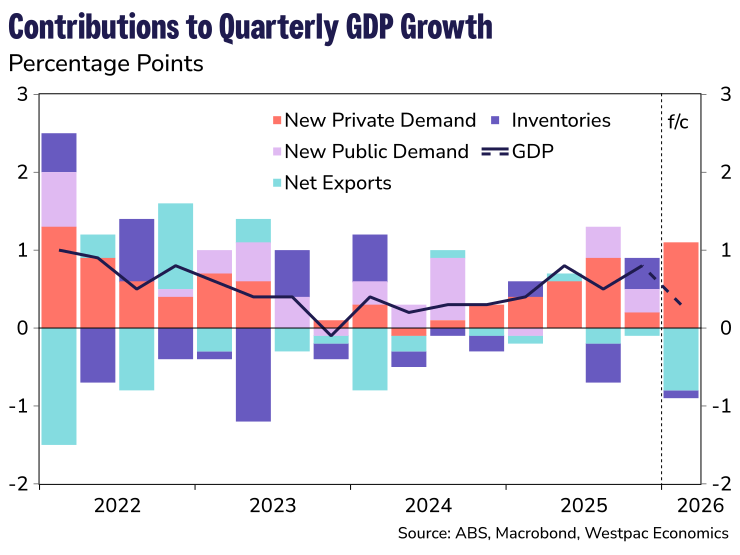
We expect new private demand to grow a very strong 1.6%qtr and 4.2%yr in Q1, comfortably outpacing growth in new public demand (flat and 2.4%yr).
The external sector and changes in inventories are expected to detract around 0.9ppts from growth in real GDP in Q1 2026 on a combined basis. While this is around 0.2ppts worse than expected in our preview due to exports, it is fully offset by a build-up in mining inventories.
As always, these “partial” indicators should be treated with caution. They are not always a reliable guide to National Accounts components, and there are significant areas of activity for which regular partial measures are not available.
Public Demand
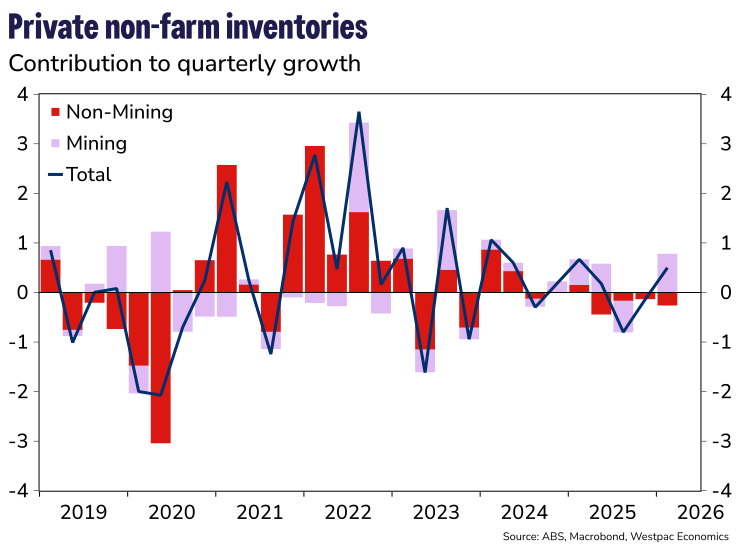
New public demand slowed materially at the start of 2026, increasing just 0.1%qtr in Q1 following gains of 0.9%qtr in Q4 and 1.2%qtr in Q3. The weakness was driven by public consumption, which fell –0.2%qtr as the Energy Bill Relief Funded ended on 31 December 2025.
Public consumption declined –0.2%qtr, a marked departure from the 0.9%qtr growth recorded in each of the previous two quarters. State and local government consumption was the primary drag, falling –0.8%qtr in Q1. Federal government consumption continued to expand, albeit at a more moderate pace, rising 0.5%qtr in Q1. The expiry of the Federal Government’s Energy Bill Relief Fund at the end of 2025 would have had a material impact on today’s numbers. Indeed, abstracting from the effects of electricity rebate roll off, we estimate total public consumption would have increased by 0.3%qtr – still slow compared to the 1.0%qtr quarterly average growth rate recorded over the past two years.
New public investment continued to trend solidly, increasing 1.1%qtr. Strength in national defence investment was particularly pronounced, rising 6.8%qtr following a 7.5%qtr gain in the previous quarter. While total general government investment remained firm (1.8%qtr), investment by public corporations declined (–1.2%), reflecting falls across both the Commonwealth and state and local governments. As several large transport projects on the East Coast near completion, public investment growth is likely to moderate, although ongoing strength in defence investment should provide some support to the headline.
External Sector
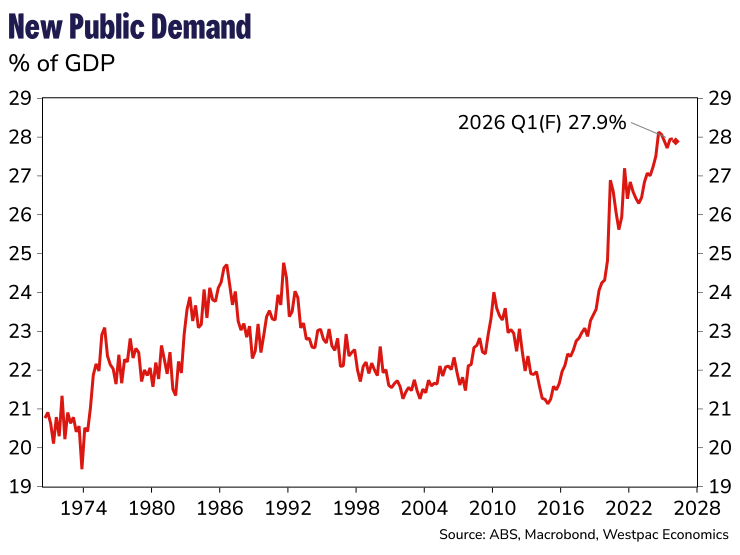
Balance of Payments data confirmed our expectation that net trade was one of key detractors from GDP growth in Q1, driven by weaker commodity outflows, falling education services exports, and a surge in capital goods imports related to data-centre investment. However, the drag of –0.8ppt was somewhat larger than anticipated, comparing with our estimate of –0.6ppt and the consensus forecast of –0.5ppt. Goods and services trade flows appear to have contributed to the negative outcome in close to equal shares.
On the exports side, volumes declined by 1.1%qtr. Goods exports fell 0.8%qtr, largely reflecting weaker shipments of major commodities, which declined 1.7%qtr, the weakest outcome in two and a half years. Severe weather events disrupted mining activity and trade in iron ore and coal – the two largest export items – resulting in declines of 1.3%qtr and 6.8%qtr respectively. Gold exports, which are typically volatile, increased by 11.6%qtr. Excluding this component, goods exports would have declined by a larger 1.7%qtr.
Services exports fell 2.1%qtr, the largest decline since the height of the pandemic. Education exports (spending by foreign students in Australia), which account for more than one-third of total services exports, were the main driver. While education exports more than doubled in the eleven years to Q2 2025, they have trended lower since then, tracking a decline in student visa holders.
On the imports side, ADP equipment imports were a clear standout, nearly doubling in real terms over the quarter (an increase of 85%qtr), and driving a marked 6.3%qtr increase in capital goods imports. These data match the signal from the private CAPEX release last week, which show data-centre investment has lifted business spending growth to rates not seen since the height of the mining boom in 2012. Elsewhere, the global energy shock saw fuel imports rise by 12.5%qtr in nominal terms; however, this increase was fully explained by price changes, with little to no change in volumes. Consumption goods import volumes declined by 0.8%qtr, pointing to downside risks for consumer spending in the quarter. Services imports increased by 3.8%qtr, driven by higher transport, travel and other services.
In nominal terms, the current account deficit widened by more than $4bn to $27.1bn, a new record high. As a share of GDP, most likely it will rise to around 3.5%, which we have not seen since late 2017. This deterioration was almost entirely due to a smaller goods trade surplus. The primary income deficit also increased, reflecting larger outflows associated with foreign ownership of Australian assets – to a significant extent, mining company profits flowing to foreign shareholders.
Inventories
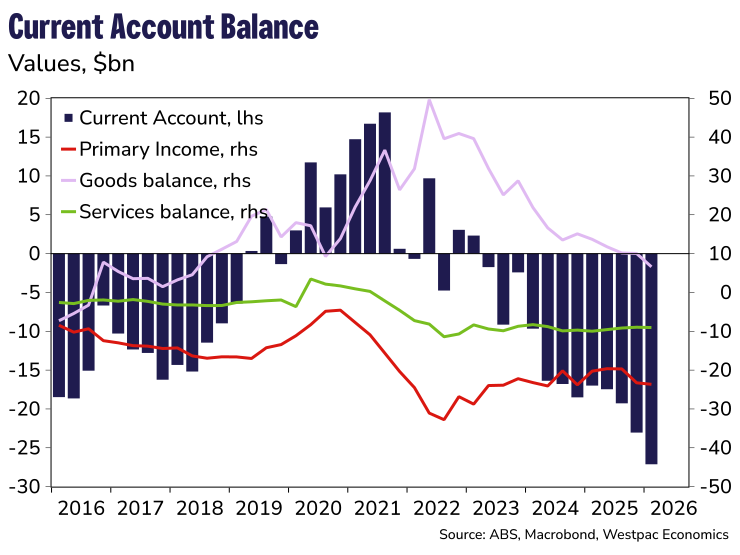
Inventories within the non-farm business sector increased 0.5% in Q1 following a modest 0.1% decline in Q4. The result was much firmer than our forecast and the market consensus, which was looking for a broadly flat outcome.
The main driver behind the upside surprise was a significant build-up in inventories within the mining sector, up 5.8%. This reflects a slowing in key commodity exports during the quarter as discussed above, with iron ore and coal disrupted by cyclones Koji and Mitchell. Elsewhere across the non-mining sector, inventories fell 0.3%. Those in more ‘consumer-facing’ industries managed to lift only slightly (+0.1%), potentially reflecting softer consumer demand (see below).
As discussed above, non-farm business inventories will add around +0.2ppts to Q1 GDP. At the same time, public inventories will detract around 0.3ppts. Together, the net impact of total non-farm inventories is a +0.1ppt contribution to Q1 GDP – broadly as we had expected in our preview, with the component makeup differing.
Sales
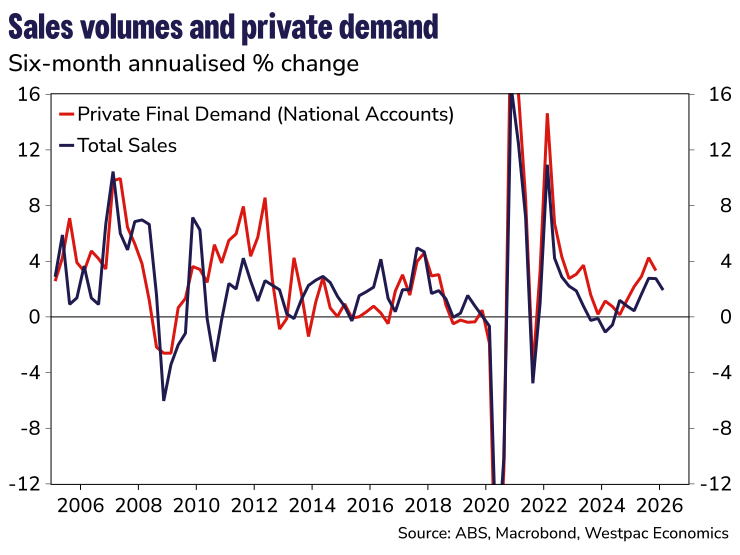
Sales volumes rose 0.2% in Q1. This is a material step down from the 0.6-0.7% quarterly pace that held from Q2 to Q4 last year. However, with an even weaker lift cycling out of the annual calculation from Q1 2025, the annual pace bumped up to 2.3%yr.
The largest gains stemmed from more business-facing industries like financial and insurance services (+2.5%), construction (+2.2%) and professional, scientific and technical services (+1.5%). This managed to offset a large decline from the mining sector (–3.1%), again attributable to weather-related disruptions for key commodity exports. Sales across consumer-facing industries were also softer, including retail trade (–0.2%), accommodation and food services (–0.6%) and arts and recreation (–0.2%). This suggests that the underlying health of the consumer was already soft in Q1, before the full impact of the Middle East conflict has materialised.
This provides us with a very general guide as to what we might expect for private demand, with today’s update suggesting it started the year on a softer footing. However, we caution that this is by no means an accurate indicator for private demand on a quarter-to-quarter basis given this survey’s lack of coverage of sectors that have being growing more strongly (e.g. health care and education), nor is it a direct input into the expenditure estimates for the National Accounts.
Company Profits
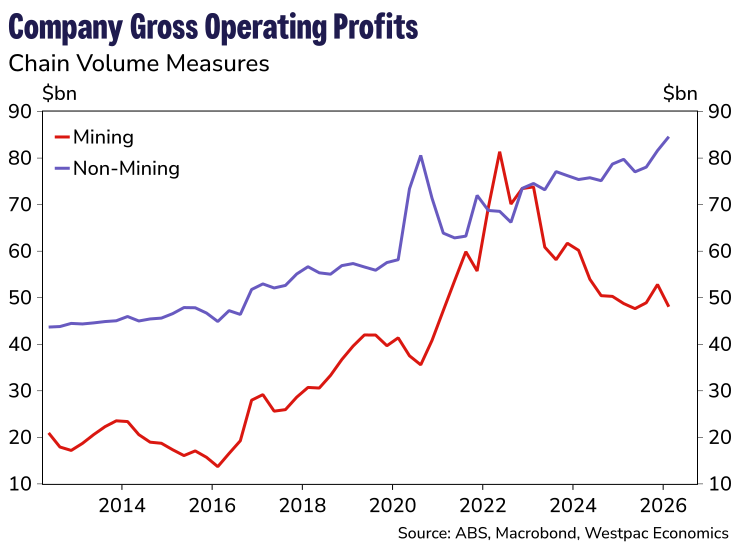
Company profits also surprised to the downside, falling 1.3% in the quarter, a weaker result versus our forecast and the consensus view for a small increase.
Once again, the chief culprit was the mining sector, where profits fell by 9.1%. Some of this is explained by lower iron ore prices and the impacts of cyclones on exports. However, part of this also reflects a normalisation from last quarter – quarterly profits have held in the $47-48bn range since early last year, bounced to just under $53bn in Q4, before returning to $48bn in Q1.
Profits in the non-mining sector was more constructive, up 3.7% (6.1%yr) and broad-based across many sectors, including construction, wholesale trade, manufacturing and information media and telecommunications.
Recall that being an accounting survey, this data incorporates changes in the prices of inventories – called the inventory valuation adjustment (IVA) – into the profit measure, but in an economic sense, IVA does not represent a true change in profitability. This has been a more prominent issue in recent times with significant quarter-to-quarter shifts in the IVA driving large swings in accounting profit measures in this survey.
Today’s data revealed that the IVA added $2.4bn to total profits in Q1, compared to adding $2.3bn in Q4. After adjusting for this, we calculate that the fall in gross operating surplus as measured in the national accounts is closer to –1.5%. The ABS also employs slightly different seasonal factors between gross operating profits in this data and official measures of gross operating surplus in the National Accounts.
Stay informed with Westpac IQ
Get the latest reports straight to your inbox.
Related articles

Australia and NZ Weekly 26 October 2026

Open mouth operations
Australia and NZ Weekly 19 October 2026
Browse topics
Disclaimer
©2026 Westpac Banking Corporation ABN 33 007 457 141 (including where acting under any of its Westpac, St George, Bank of Melbourne or BankSA brands, collectively, “Westpac”). References to the “Westpac Group” are to Westpac and its subsidiaries and includes the directors, employees and representatives of Westpac and its subsidiaries.
Things you should know
We respect your privacy: You can view the New Zealand Privacy Policy here, or the Australian Group Privacy Statement here. Each time someone visits our site, data is captured so that we can accurately evaluate the quality of our content and make improvements for you. We may at times use technology to capture data about you to help us to better understand you and your needs, including potentially for the purposes of assessing your individual reading habits and interests to allow us to provide suggestions regarding other reading material which may be suitable for you.
This information, unless specifically indicated otherwise, is under copyright of the Westpac Group. None of the material, nor its contents, nor any copy of it, may be altered in any way, transmitted to, copied of distributed to any other party without the prior written permission of the Westpac Group.
Disclaimer
This information has been prepared by Westpac and is intended for information purposes only. It is not intended to reflect any recommendation or financial advice and investment decisions should not be based on it. This information does not constitute an offer, a solicitation of an offer, or an inducement to subscribe for, purchase or sell any financial instrument or to enter into a legally binding contract. To the extent that this information contains any general advice, it has been prepared without taking into account your objectives, financial situation or needs and before acting on it you should consider the appropriateness of the advice. Certain types of transactions, including those involving futures, options and high yield securities give rise to substantial risk and are not suitable for all investors. We recommend that you seek your own independent legal or financial advice before proceeding with any investment decision.
This information may contain material provided by third parties. While such material is published with the necessary permission none of Westpac or its related entities accepts any responsibility for the accuracy or completeness of any such material. Although we have made every effort to ensure this information is free from error, none of Westpac or its related entities warrants the accuracy, adequacy or completeness of this information, or otherwise endorses it in any way. Except where contrary to law, Westpac Group intend by this notice to exclude liability for this information. This information is subject to change without notice and none of Westpac or its related entities is under any obligation to update this information or correct any inaccuracy which may become apparent at a later date. This information may contain or incorporate by reference forward-looking statements. The words “believe”, “anticipate”, “expect”, “intend”, “plan”, “predict”, “continue”, “assume”, “positioned”, “may”, “will”, “should”, “shall”, “risk” and other similar expressions that are predictions of or indicate future events and future trends identify forward-looking statements. These forward-looking statements include all matters that are not historical facts. Past performance is not a reliable indicator of future performance, nor are forecasts of future performance. Whilst every effort has been taken to ensure that the assumptions on which any forecasts are based are reasonable, the forecasts may be affected by incorrect assumptions or by known or unknown risks and uncertainties. The ultimate outcomes may differ substantially from any forecasts.
Conflicts of Interest: In the normal course of offering banking products and services to its clients, the Westpac Group may act in several capacities (including issuer, market maker, underwriter, distributor, swap counterparty and calculation agent) simultaneously with respect to a financial instrument, giving rise to potential conflicts of interest which may impact the performance of a financial instrument. The Westpac Group may at any time transact or hold a position (including hedging and trading positions) for its own account or the account of a client in any financial instrument which may impact the performance of that financial instrument.
Author(s) disclaimer and declaration: The author(s) confirms that (a) no part of his/her compensation was, is, or will be, directly or indirectly, related to any views or (if applicable) recommendations expressed in this material; (b) this material accurately reflects his/her personal views about the financial products, companies or issuers (if applicable) and is based on sources reasonably believed to be reliable and accurate; (c) to the best of the author’s knowledge, they are not in receipt of inside information and this material does not contain inside information; and (d) no other part of the Westpac Group has made any attempt to influence this material.
Further important information regarding sustainability-related content: This material may contain statements relating to environmental, social and governance (ESG) topics. These are subject to known and unknown risks, and there are significant uncertainties, limitations, risks and assumptions in the metrics, modelling, data, scenarios, reporting and analysis on which the statements rely. In particular, these areas are rapidly evolving and maturing, and there are variations in approaches and common standards and practice, as well as uncertainty around future related policy and legislation. Some material may include information derived from publicly available sources that have not been independently verified. No representation or warranty is made as to the accuracy, completeness or reliability of the information. There is a risk that the analysis, estimates, judgements, assumptions, views, models, scenarios or projections used may turn out to be incorrect. These risks may cause actual outcomes to differ materially from those expressed or implied. The ESG-related statements in this material do not constitute advice, nor are they guarantees or predictions of future performance, and Westpac gives no representation, warranty or assurance (including as to the quality, accuracy or completeness of the statements). You should seek your own independent advice.
Additional country disclosures:
Australia: Westpac holds an Australian Financial Services Licence (No. 233714). You can access Westpac’s Financial Services Guide here or request a copy from your Westpac point of contact. To the extent that this information contains any general advice, it has been prepared without taking into account your objectives, financial situation or needs and before acting on it you should consider the appropriateness of the advice.
New Zealand: In New Zealand, Westpac Institutional Bank refers to the brand under which products and services are provided by either Westpac (NZ division) or Westpac New Zealand Limited (company number 1763882), the New Zealand incorporated subsidiary of Westpac ("WNZL"). Any product or service made available by WNZL does not represent an offer from Westpac or any of its subsidiaries (other than WNZL). Neither Westpac nor its other subsidiaries guarantee or otherwise support the performance of WNZL in respect of any such product. WNZL is not an authorised deposit-taking institution for the purposes of Australian prudential standards. The current disclosure statements for the New Zealand branch of Westpac and WNZL can be obtained at the internet address www.westpac.co.nz.
Singapore: This material has been prepared and issued for distribution in Singapore to institutional investors, accredited investors and expert investors (as defined in the applicable Singapore laws and regulations) only. Recipients of this material in Singapore should contact Westpac Singapore Branch in respect of any matters arising from, or in connection with, this material. Westpac Singapore Branch holds a wholesale banking licence and is subject to supervision by the Monetary Authority of Singapore.
Fiji: Unless otherwise specified, the products and services for Westpac Fiji are available from www.westpac.com.fj © Westpac Banking Corporation ABN 33 007 457 141. This information does not take your personal circumstances into account and before acting on it you should consider the appropriateness of the information for your financial situation. Westpac Banking Corporation ABN 33 007 457 141 is incorporated in NSW Australia and registered as a branch in Fiji. The liability of its members is limited.
Papua New Guinea: Unless otherwise specified, the products and services for Westpac PNG are available from www.westpac.com.pg © Westpac Banking Corporation ABN 33 007 457 141. This information does not take your personal circumstances into account and before acting on it you should consider the appropriateness of the information for your financial situation. Westpac Banking Corporation ABN 33 007 457 141 is incorporated in NSW Australia. Westpac is represented in Papua New Guinea by Westpac Bank - PNG - Limited. The liability of its members is limited.
U.S.: Westpac operates in the United States of America as a federally licensed branch, regulated by the Office of the Comptroller of the Currency. Westpac is also registered with the US Commodity Futures Trading Commission (“CFTC”) as a Swap Dealer, but is neither registered as, or affiliated with, a Futures Commission Merchant registered with the US CFTC. The services and products referenced above are not insured by the Federal Deposit Insurance Corporation (“FDIC”). Westpac Capital Markets, LLC (‘WCM’), a wholly-owned subsidiary of Westpac, is a broker-dealer registered under the U.S. Securities Exchange Act of 1934 (‘the Exchange Act’) and member of the Financial Industry Regulatory Authority (‘FINRA’). In accordance with APRA's Prudential Standard 222 'Association with Related Entities', Westpac does not stand behind WCM other than as provided for in certain legal agreements between Westpac and WCM and obligations of WCM do not represent liabilities of Westpac.
This communication is provided for distribution to U.S. institutional investors in reliance on the exemption from registration provided by Rule 15a-6 under the Exchange Act and is not subject to all of the independence and disclosure standards applicable to debt research reports prepared for retail investors in the United States. WCM is the U.S. distributor of this communication and accepts responsibility for the contents of this communication. Transactions by U.S. customers of any securities referenced herein should be effected through WCM. All disclaimers set out with respect to Westpac apply equally to WCM. If you would like to speak to someone regarding any security mentioned herein, please contact WCM on +1 212 389 1269. Investing in any non-U.S. securities or related financial instruments mentioned in this communication may present certain risks. The securities of non-U.S. issuers may not be registered with, or be subject to the regulations of, the SEC in the United States. Information on such non-U.S. securities or related financial instruments may be limited. Non-U.S. companies may not be subject to audit and reporting standards and regulatory requirements comparable to those in effect in the United States. The value of any investment or income from any securities or related derivative instruments denominated in a currency other than U.S. dollars is subject to exchange rate fluctuations that may have a positive or adverse effect on the value of or income from such securities or related derivative instruments.
The author of this communication is employed by Westpac and is not registered or qualified as a research analyst, representative, or associated person of WCM or any other U.S. broker-dealer under the rules of FINRA, any other U.S. self-regulatory organisation, or the laws, rules or regulations of any State. Unless otherwise specifically stated, the views expressed herein are solely those of the author and may differ from the information, views or analysis expressed by Westpac and/or its affiliates.
UK: The London branch of Westpac is authorised in the United Kingdom by the Prudential Regulation Authority (PRA) and is subject to regulation by the Financial Conduct Authority (FCA) and limited regulation by the PRA (Financial Services Register number: 124586). The London branch of Westpac is registered at Companies House as a branch established in the United Kingdom (Branch No. BR000106). Details about the extent of the regulation of Westpac’s London branch by the PRA are available from us on request.
This communication is not being made to or distributed to, and must not be passed on to, the general public in the United Kingdom. Rather, this communication is being made only to and is directed at (a) those persons falling within the definition of Investment Professionals (set out in Article 19(5) of the Financial Services and Markets Act 2000 (Financial Promotion) Order 2005 (the “Order”)); (b) those persons falling within the definition of high net worth companies, unincorporated associations etc. (set out in Article 49(2)of the Order; (c) other persons to whom it may lawfully be communicated in accordance with the Order or (d) any persons to whom it may otherwise lawfully be made (all such persons together being referred to as “relevant persons”). Any person who is not a relevant person should not act or rely on this communication or any of its contents. In the same way, the information contained in this communication is intended for “eligible counterparties” and “professional clients” as defined by the rules of the Financial Conduct Authority and is not intended for “retail clients”. Westpac expressly prohibits you from passing on the information in this communication to any third party.
European Economic Area (“EEA”): This material may be distributed to you by either: (i) Westpac directly, or (ii) Westpac Europe GmbH (“WEG”) under a sub-licensing arrangement. WEG has not edited or otherwise modified the content of this material. WEG is authorised in Germany by the Federal Financial Supervision Authority (‘BaFin’) and subject to its regulation. WEG’s supervisory authorities are BaFin and the German Federal Bank (‘Deutsche Bundesbank’). WEG is registered with the commercial register (‘Handelsregister’) of the local court of Frankfurt am Main under registration number HRB 118483. In accordance with APRA’s Prudential Standard 222 ‘Association with Related Entities’, Westpac does not stand behind WEG other than as provided for in certain legal agreements (a risk transfer, sub-participation and collateral agreement) between Westpac and WEG and obligations of WEG do not represent liabilities of Westpac. Any product or service made available by WEG does not represent an offer from Westpac or any of its subsidiaries (other than WEG). All disclaimers set out with respect to Westpac apply equally to WEG.
This communication is not intended for distribution to, or use by any person or entity in any jurisdiction or country where such distribution or use would be contrary to local law or regulation.
This communication contains general commentary, research, and market colour. The communication does not constitute investment advice. The material may contain an ‘investment recommendation’ and/or ‘information recommending or suggesting an investment’, both as defined in Regulation (EU) No 596/2014 (including as applicable in the United Kingdom) (“MAR”). In accordance with the relevant provisions of MAR, reasonable care has been taken to ensure that the material has been objectively presented and that interests or conflicts of interest of the sender concerning the financial instruments to which that information relates have been disclosed.
Investment recommendations must be read alongside the specific disclosure which accompanies them and the general disclosure which can be found here. Such disclosure fulfils certain additional information requirements of MAR and associated delegated legislation and by accepting this communication you acknowledge that you are aware of the existence of such additional disclosure and its contents.
To the extent this communication comprises an investment recommendation it is classified as non-independent research. It has not been prepared in accordance with legal requirements designed to promote the independence of investment research and therefore constitutes a marketing communication. Further, this communication is not subject to any prohibition on dealing ahead of the dissemination of investment research.