June Labour Force Preview

Forward-looking business survey measures point to sluggish employment growth ahead. Rising underemployment also suggests that slack is building more broadly across the labour market.

- The May LFS gave us a clearer read on the underlying trend now that recent sources of noise have faded. With employment growth effectively stalling over April and May, we think some genuine weakness is starting to form.
- For June, we have pencilled in a lift in employment of 15k, with the participation rate steady at 66.7% and the unemployment rate remaining at 4.4%. Forward-looking business survey measures point to sluggish employment growth ahead.
- The ABS noted a “systems error” in the initial release of the May LFS leading to the incorrect underemployment data being published. The corrected figures materially change the interpretation of the recent trend from broadly sideways to rising materially.
- New unofficial underemployment measures have also lifted notably over recent months, well ahead of and by far more than the official underemployment rate. The longer these trends persist, the stronger the case that slack is building more broadly across the labour market..
Looking through the noise in recent data
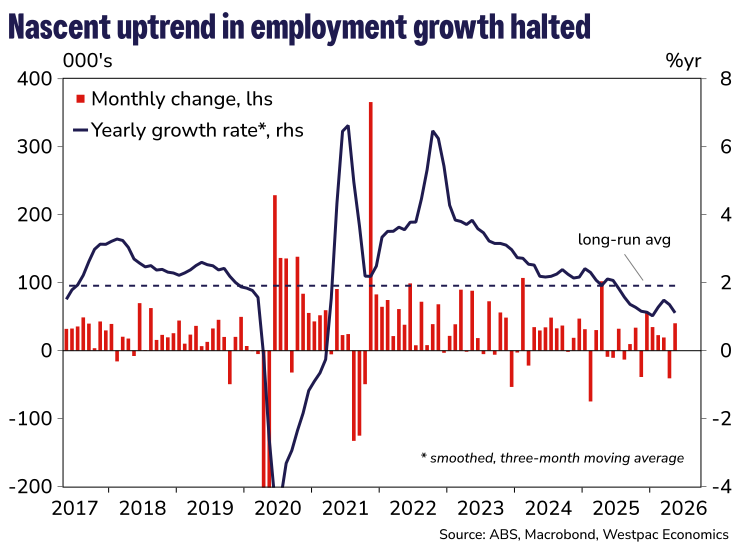
The May LFS was in line with our forecasts: employment bounced back +40.3k while the unemployment rate edged down from 4.5% to 4.4%. We had previously flagged two major sources of noise: (1) large downward revisions to earlier employment estimates following re-benchmarking to new population estimates; and (2) the unwind of an ‘abnormal seasonality’ linked to the April survey being conducted over the Easter long weekend.
May’s data gave us a clearer read on the underlying trend now that these sources of noise have faded – and in our view, genuine weakness appears to be forming. After expanding around +26k/mth in Q1, employment growth effectively stalled over April and May. On a three-month average basis, employment is growing well below the pace of the working-age population (1.1%yr versus 1.8%yr), leaving the employment-to-population ratio around 0.7ppts below its recent historical high. Since the participation rate has held up a bit better – only 0.4ppts off its peak and averaging about 66.7% so far this year – the unemployment rate has continued to grind higher.
The brief recovery around the start of the year has well and truly faded. Higher inflation and recent interest rate rises will still take time to fully work its way through to the economy and the labour market, but for now, the labour market is looking weaker than it did earlier in the year..
What are we expecting for June?
We have pencilled in a lift in employment of 15k, but with the participation rate steady at 66.7%, we think the unemployment rate will also remain at 4.4% (though we have it rounding up at two decimal places). While the contemporaneous relationship between the LFS and other partial indicators is patchy at best, the nudge lower in job ads and softness in the monthly business surveys give little reason to expect a significant upside surprise.
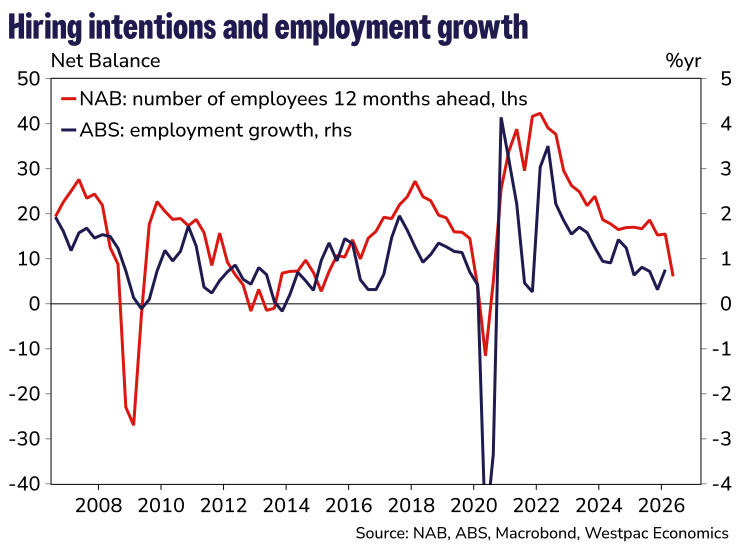
More importantly, forward-looking business survey measures point to sluggish employment growth ahead. NAB’s Q2 business survey reported a sizeable decline in year-ahead employment expectations, the –9pt fall being the largest since the pandemic. This series is typically more stable than monthly and quarterly measures of current employment and near-term employment expectations, and may be a more useful guide to medium-term shifts in hiring. Ordinarily, a decline of this size would signal more sustained weakness to come. While there are some questions around the timing of the quarterly survey, which was in the field when uncertainty around the Middle East conflict was particularly high, this sort of volatility usually has much less impact on year-ahead employment plans than current employment or near-term employment expectations. In any case, given the re-escalation in tensions in recent weeks, these concerns might not have fully faded.
We remain comfortable with our view that slow employment growth will see a further rise in unemployment over the rest of the year. This also reflects labour force participation holding up better than employment, a notion supported by the recent rise in underemployment discussed below.
Notable revision to the May LFS
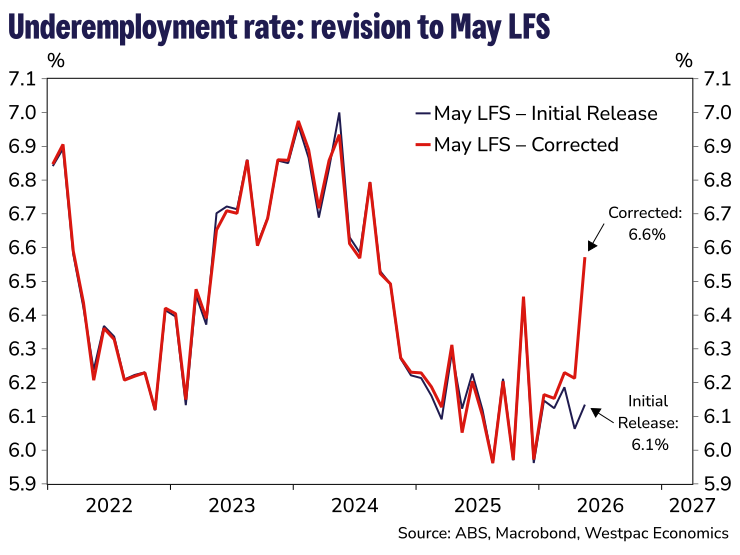
One-and-a-half weeks after publishing the May LFS, the ABS issued a notice identifying an error in the underemployment data. The ABS later clarified this as a “systems error”, meaning the originally published underemployment data was incorrect. It has since issued revised estimates and difference is quite stark.
Recall that underemployment largely refers to part-time workers wanting more hours, along with a smaller group of full-time workers who worked part-time hours during the survey period. May’s underemployment rate was revised up ½ppt from 6.1% to 6.6%, the highest since August 2024.
Recent months were also revised up to a lesser extent, changing the interpretation of the recent trend from broadly sideways to rising materially. As noted below, supplementary unofficial measures of underemployment suggest the large rise in May is more than noise.
The lift in underemployment likely reflects a mix of both demand-side and supply-side factors. As noted above, employment growth and business surveys suggest labour demand is softening. At the same time, high inflation and rising interest rates are likely inducing more workers to search for additional hours of work to offset cost-of-living pressures. Both sets of factors could be driving increased labour market slack and may be a pointer to higher measured unemployment down the track.
Primer on the 'u-series'
The ABS is expanding its suite of underutilisation statistics into a broader group of measures dubbed the ‘u-series’ that may provide more insights into labour market slack. The headline unemployment and underemployment rates currently reported in the LFS are based on specific criteria around an individual’s availability and their efforts to search for work or additional hours. But many individuals that are notionally unemployed or underemployed may fall just outside of those definitions – for example, because they searched for work passively rather than actively, or because they are available within four weeks but not the last week.
The ‘u-series’ expands these availability and search criteria to measure broader groups of underutilised workers. For now, the measures remain ‘unofficial’ while the new collection model is rolled out. The ABS expects the ‘u-series’ to become the official headline estimates of underutilisation by mid-2027.
Longer time series will be needed before we can properly assess these measures. Once that history is provided, we will publish a note explaining the differences between the measures in more detail and how we intend to incorporate them into our own analysis.
Unofficial underemployment measures also point to growing slack
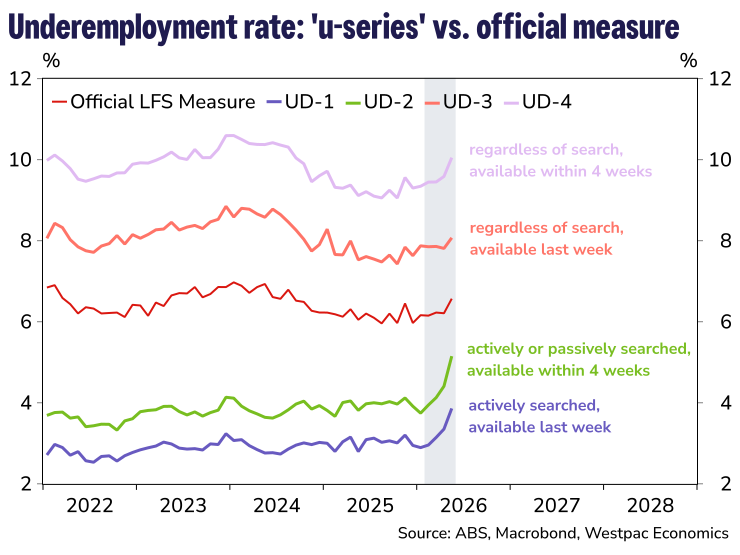
There are four ‘u-series’ underemployment measures, labelled UD-1 through to UD-4. The narrowest measure is UD-1, with each successive grouping loosening the criteria in some way to capture a larger group of underemployed persons, with UD-4 being the broadest. Specifically, from narrowest to broadest, the definitions are:
- UD-1: Prefers and actively looked for more hours, available last week.
- UD-2: Prefers and looked (active or passive) for more hours, available within 4 weeks.
- UD-3: Prefers more hours, available last week (regardless if looked).
- UD-4: Prefers more hours, available within 4 weeks (regardless if looked).
Over the past few months, some of these ‘u-series’ measures of underemployment have lifted notably, well ahead of and by far more than the official underemployment rate, as seen in the chart below. Since February, the ‘broadest’ measure (UD-4) has risen 0.6ppts, whereas the ‘narrowest’ measure (UD-1) has posted a larger increase of 0.9ppts. This not only tells us that there has been an increase in total underemployment in the broadest sense, but there has also been shift within the underemployed – more are now currently available and are more actively searching for more hours.
Given the unofficial and provisional nature of this data, we would not want to overemphasise these readings while the ABS is still rolling out changes to the LFS. But the longer these trends persist across both official and unofficial data, the stronger the case that slack is building more broadly across the labour market
Stay informed with Westpac IQ
Get the latest reports straight to your inbox.
Related articles

September Labour Force: looking shakier
September Labour Force Preview
Browse topics
Disclaimer
©2026 Westpac Banking Corporation ABN 33 007 457 141 (including where acting under any of its Westpac, St George, Bank of Melbourne or BankSA brands, collectively, “Westpac”). References to the “Westpac Group” are to Westpac and its subsidiaries and includes the directors, employees and representatives of Westpac and its subsidiaries.
Things you should know
We respect your privacy: You can view the New Zealand Privacy Policy here, or the Australian Group Privacy Statement here. Each time someone visits our site, data is captured so that we can accurately evaluate the quality of our content and make improvements for you. We may at times use technology to capture data about you to help us to better understand you and your needs, including potentially for the purposes of assessing your individual reading habits and interests to allow us to provide suggestions regarding other reading material which may be suitable for you.
This information, unless specifically indicated otherwise, is under copyright of the Westpac Group. None of the material, nor its contents, nor any copy of it, may be altered in any way, transmitted to, copied of distributed to any other party without the prior written permission of the Westpac Group.
Disclaimer
This information has been prepared by Westpac and is intended for information purposes only. It is not intended to reflect any recommendation or financial advice and investment decisions should not be based on it. This information does not constitute an offer, a solicitation of an offer, or an inducement to subscribe for, purchase or sell any financial instrument or to enter into a legally binding contract. To the extent that this information contains any general advice, it has been prepared without taking into account your objectives, financial situation or needs and before acting on it you should consider the appropriateness of the advice. Certain types of transactions, including those involving futures, options and high yield securities give rise to substantial risk and are not suitable for all investors. We recommend that you seek your own independent legal or financial advice before proceeding with any investment decision.
This information may contain material provided by third parties. While such material is published with the necessary permission none of Westpac or its related entities accepts any responsibility for the accuracy or completeness of any such material. Although we have made every effort to ensure this information is free from error, none of Westpac or its related entities warrants the accuracy, adequacy or completeness of this information, or otherwise endorses it in any way. Except where contrary to law, Westpac Group intend by this notice to exclude liability for this information. This information is subject to change without notice and none of Westpac or its related entities is under any obligation to update this information or correct any inaccuracy which may become apparent at a later date. This information may contain or incorporate by reference forward-looking statements. The words “believe”, “anticipate”, “expect”, “intend”, “plan”, “predict”, “continue”, “assume”, “positioned”, “may”, “will”, “should”, “shall”, “risk” and other similar expressions that are predictions of or indicate future events and future trends identify forward-looking statements. These forward-looking statements include all matters that are not historical facts. Past performance is not a reliable indicator of future performance, nor are forecasts of future performance. Whilst every effort has been taken to ensure that the assumptions on which any forecasts are based are reasonable, the forecasts may be affected by incorrect assumptions or by known or unknown risks and uncertainties. The ultimate outcomes may differ substantially from any forecasts.
Conflicts of Interest: In the normal course of offering banking products and services to its clients, the Westpac Group may act in several capacities (including issuer, market maker, underwriter, distributor, swap counterparty and calculation agent) simultaneously with respect to a financial instrument, giving rise to potential conflicts of interest which may impact the performance of a financial instrument. The Westpac Group may at any time transact or hold a position (including hedging and trading positions) for its own account or the account of a client in any financial instrument which may impact the performance of that financial instrument.
Author(s) disclaimer and declaration: The author(s) confirms that (a) no part of his/her compensation was, is, or will be, directly or indirectly, related to any views or (if applicable) recommendations expressed in this material; (b) this material accurately reflects his/her personal views about the financial products, companies or issuers (if applicable) and is based on sources reasonably believed to be reliable and accurate; (c) to the best of the author’s knowledge, they are not in receipt of inside information and this material does not contain inside information; and (d) no other part of the Westpac Group has made any attempt to influence this material.
Further important information regarding sustainability-related content: This material may contain statements relating to environmental, social and governance (ESG) topics. These are subject to known and unknown risks, and there are significant uncertainties, limitations, risks and assumptions in the metrics, modelling, data, scenarios, reporting and analysis on which the statements rely. In particular, these areas are rapidly evolving and maturing, and there are variations in approaches and common standards and practice, as well as uncertainty around future related policy and legislation. Some material may include information derived from publicly available sources that have not been independently verified. No representation or warranty is made as to the accuracy, completeness or reliability of the information. There is a risk that the analysis, estimates, judgements, assumptions, views, models, scenarios or projections used may turn out to be incorrect. These risks may cause actual outcomes to differ materially from those expressed or implied. The ESG-related statements in this material do not constitute advice, nor are they guarantees or predictions of future performance, and Westpac gives no representation, warranty or assurance (including as to the quality, accuracy or completeness of the statements). You should seek your own independent advice.
Additional country disclosures:
Australia: Westpac holds an Australian Financial Services Licence (No. 233714). You can access Westpac’s Financial Services Guide here or request a copy from your Westpac point of contact. To the extent that this information contains any general advice, it has been prepared without taking into account your objectives, financial situation or needs and before acting on it you should consider the appropriateness of the advice.
New Zealand: In New Zealand, Westpac Institutional Bank refers to the brand under which products and services are provided by either Westpac (NZ division) or Westpac New Zealand Limited (company number 1763882), the New Zealand incorporated subsidiary of Westpac ("WNZL"). Any product or service made available by WNZL does not represent an offer from Westpac or any of its subsidiaries (other than WNZL). Neither Westpac nor its other subsidiaries guarantee or otherwise support the performance of WNZL in respect of any such product. WNZL is not an authorised deposit-taking institution for the purposes of Australian prudential standards. The current disclosure statements for the New Zealand branch of Westpac and WNZL can be obtained at the internet address www.westpac.co.nz.
Singapore: This material has been prepared and issued for distribution in Singapore to institutional investors, accredited investors and expert investors (as defined in the applicable Singapore laws and regulations) only. Recipients of this material in Singapore should contact Westpac Singapore Branch in respect of any matters arising from, or in connection with, this material. Westpac Singapore Branch holds a wholesale banking licence and is subject to supervision by the Monetary Authority of Singapore.
Fiji: Unless otherwise specified, the products and services for Westpac Fiji are available from www.westpac.com.fj © Westpac Banking Corporation ABN 33 007 457 141. This information does not take your personal circumstances into account and before acting on it you should consider the appropriateness of the information for your financial situation. Westpac Banking Corporation ABN 33 007 457 141 is incorporated in NSW Australia and registered as a branch in Fiji. The liability of its members is limited.
Papua New Guinea: Unless otherwise specified, the products and services for Westpac PNG are available from www.westpac.com.pg © Westpac Banking Corporation ABN 33 007 457 141. This information does not take your personal circumstances into account and before acting on it you should consider the appropriateness of the information for your financial situation. Westpac Banking Corporation ABN 33 007 457 141 is incorporated in NSW Australia. Westpac is represented in Papua New Guinea by Westpac Bank - PNG - Limited. The liability of its members is limited.
U.S.: Westpac operates in the United States of America as a federally licensed branch, regulated by the Office of the Comptroller of the Currency. Westpac is also registered with the US Commodity Futures Trading Commission (“CFTC”) as a Swap Dealer, but is neither registered as, or affiliated with, a Futures Commission Merchant registered with the US CFTC. The services and products referenced above are not insured by the Federal Deposit Insurance Corporation (“FDIC”). Westpac Capital Markets, LLC (‘WCM’), a wholly-owned subsidiary of Westpac, is a broker-dealer registered under the U.S. Securities Exchange Act of 1934 (‘the Exchange Act’) and member of the Financial Industry Regulatory Authority (‘FINRA’). In accordance with APRA's Prudential Standard 222 'Association with Related Entities', Westpac does not stand behind WCM other than as provided for in certain legal agreements between Westpac and WCM and obligations of WCM do not represent liabilities of Westpac.
This communication is provided for distribution to U.S. institutional investors in reliance on the exemption from registration provided by Rule 15a-6 under the Exchange Act and is not subject to all of the independence and disclosure standards applicable to debt research reports prepared for retail investors in the United States. WCM is the U.S. distributor of this communication and accepts responsibility for the contents of this communication. Transactions by U.S. customers of any securities referenced herein should be effected through WCM. All disclaimers set out with respect to Westpac apply equally to WCM. If you would like to speak to someone regarding any security mentioned herein, please contact WCM on +1 212 389 1269. Investing in any non-U.S. securities or related financial instruments mentioned in this communication may present certain risks. The securities of non-U.S. issuers may not be registered with, or be subject to the regulations of, the SEC in the United States. Information on such non-U.S. securities or related financial instruments may be limited. Non-U.S. companies may not be subject to audit and reporting standards and regulatory requirements comparable to those in effect in the United States. The value of any investment or income from any securities or related derivative instruments denominated in a currency other than U.S. dollars is subject to exchange rate fluctuations that may have a positive or adverse effect on the value of or income from such securities or related derivative instruments.
The author of this communication is employed by Westpac and is not registered or qualified as a research analyst, representative, or associated person of WCM or any other U.S. broker-dealer under the rules of FINRA, any other U.S. self-regulatory organisation, or the laws, rules or regulations of any State. Unless otherwise specifically stated, the views expressed herein are solely those of the author and may differ from the information, views or analysis expressed by Westpac and/or its affiliates.
UK: The London branch of Westpac is authorised in the United Kingdom by the Prudential Regulation Authority (PRA) and is subject to regulation by the Financial Conduct Authority (FCA) and limited regulation by the PRA (Financial Services Register number: 124586). The London branch of Westpac is registered at Companies House as a branch established in the United Kingdom (Branch No. BR000106). Details about the extent of the regulation of Westpac’s London branch by the PRA are available from us on request.
This communication is not being made to or distributed to, and must not be passed on to, the general public in the United Kingdom. Rather, this communication is being made only to and is directed at (a) those persons falling within the definition of Investment Professionals (set out in Article 19(5) of the Financial Services and Markets Act 2000 (Financial Promotion) Order 2005 (the “Order”)); (b) those persons falling within the definition of high net worth companies, unincorporated associations etc. (set out in Article 49(2)of the Order; (c) other persons to whom it may lawfully be communicated in accordance with the Order or (d) any persons to whom it may otherwise lawfully be made (all such persons together being referred to as “relevant persons”). Any person who is not a relevant person should not act or rely on this communication or any of its contents. In the same way, the information contained in this communication is intended for “eligible counterparties” and “professional clients” as defined by the rules of the Financial Conduct Authority and is not intended for “retail clients”. Westpac expressly prohibits you from passing on the information in this communication to any third party.
European Economic Area (“EEA”): This material may be distributed to you by either: (i) Westpac directly, or (ii) Westpac Europe GmbH (“WEG”) under a sub-licensing arrangement. WEG has not edited or otherwise modified the content of this material. WEG is authorised in Germany by the Federal Financial Supervision Authority (‘BaFin’) and subject to its regulation. WEG’s supervisory authorities are BaFin and the German Federal Bank (‘Deutsche Bundesbank’). WEG is registered with the commercial register (‘Handelsregister’) of the local court of Frankfurt am Main under registration number HRB 118483. In accordance with APRA’s Prudential Standard 222 ‘Association with Related Entities’, Westpac does not stand behind WEG other than as provided for in certain legal agreements (a risk transfer, sub-participation and collateral agreement) between Westpac and WEG and obligations of WEG do not represent liabilities of Westpac. Any product or service made available by WEG does not represent an offer from Westpac or any of its subsidiaries (other than WEG). All disclaimers set out with respect to Westpac apply equally to WEG.
This communication is not intended for distribution to, or use by any person or entity in any jurisdiction or country where such distribution or use would be contrary to local law or regulation.
This communication contains general commentary, research, and market colour. The communication does not constitute investment advice. The material may contain an ‘investment recommendation’ and/or ‘information recommending or suggesting an investment’, both as defined in Regulation (EU) No 596/2014 (including as applicable in the United Kingdom) (“MAR”). In accordance with the relevant provisions of MAR, reasonable care has been taken to ensure that the material has been objectively presented and that interests or conflicts of interest of the sender concerning the financial instruments to which that information relates have been disclosed.
Investment recommendations must be read alongside the specific disclosure which accompanies them and the general disclosure which can be found here. Such disclosure fulfils certain additional information requirements of MAR and associated delegated legislation and by accepting this communication you acknowledge that you are aware of the existence of such additional disclosure and its contents.
To the extent this communication comprises an investment recommendation it is classified as non-independent research. It has not been prepared in accordance with legal requirements designed to promote the independence of investment research and therefore constitutes a marketing communication. Further, this communication is not subject to any prohibition on dealing ahead of the dissemination of investment research.