Sustainable Finance Market Update Q2 2026
Welcome to our Q2 2026 Sustainable Finance Market Update, which also includes a two-minute video highlighting key developments across the sustainable finance landscape. In this edition, we review first-half market activity, highlight notable sustainable finance transactions and explore how sustainability-linked and use-of-proceeds financing are supporting the continued evolution of Australia's Living sector. We also reflect on a quarter that saw the Federal Budget handed down and important regulatory and policy developments for the sustainable finance market.
Market recap - Q2 2026
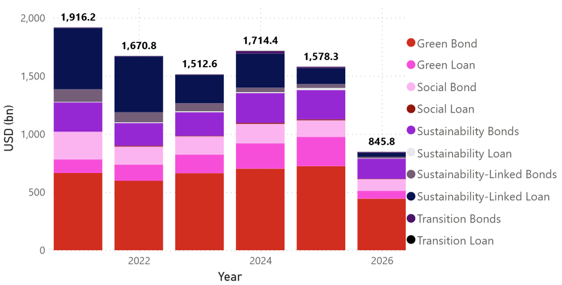
Figure 1 – Global Sustainable Finance Issuance by Year. Source: Bloomberg/Westpac
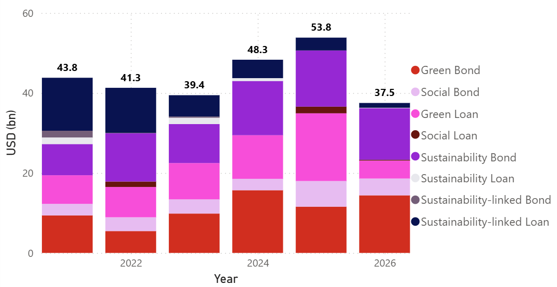
Figure 2 – Australian Sustainable Finance Issuance by Year. Source: Bloomberg/Westpac
Global sustainable debt issuance reached USD 846bn in the first half of 2026, continuing the strong momentum seen across labelled debt markets over the past few years. Australia recorded a record first half, with sustainable debt issuance reaching USD 37.5bn, up from USD 32.4bn in H1 2025 and well above historical levels. However, the market remains increasingly two-speed in nature. Sustainable bond issuance continues to grow, while sustainable loan volumes remain subdued relative to historical levels. Much of this divergence reflects the moderation in Sustainability-Linked Loan issuance, which has not recovered to the levels observed during 2021 and 2022, while Green and Sustainability Bond issuance continues to underpin volumes across labelled loan markets.
Sustainable Bonds
Globally, sustainable bonds continued to dominate overall issuance, accounting for almost 90% of total sustainable debt volumes during H1 2026. Sustainable bond issuance reached a record USD 735bn, supported by strong activity across Green, Social and Sustainability Bonds.
- Green Bonds remained the largest labelled debt product globally and in Australia.
- Social Bond and Sustainability Bond issuance also remained strong, contributing to record global sustainable bond volumes.
- Australian sustainable bond issuance reached USD 24bn in H1 2026, reflecting continued demand for labelled bonds and a healthy pipeline of domestic and Kangaroo issuance.
Sustainable Loans
While sustainable debt markets reached new highs, sustainable loan issuance remained subdued relative to the peaks observed during 2021 and 2022.
- Global sustainable loan issuance totalled USD 110bn during H1 2026, down on previous years and almost half of 2025 volumes.
- Green Loans remained the dominant loan sub-label globally and in Australia.
- Australian sustainable loan issuance totalled USD 6bn in H1 2026, with Green Loans accounting for the majority of activity and Sustainability-Linked Loan issuance continuing to moderate.
Themes and Trends
Renewable energy remained a dominant theme across green bond issuance in the first half of 2026, alongside continued activity in green buildings and clean transportation. Together, these three categories accounted for more than 60% of green bond use-of-proceeds allocations, underscoring the continued focus on established decarbonisation sectors. From a regional perspective, Europe, the Middle East and Africa had a particularly strong start to the year, representing approximately 40% of total labelled issuance across H1 2026. Despite record sustainable debt volumes, labelled debt as a share of total market issuance has remained relatively steady around the 5% mark, recording 4.6% in May.
Notable Sustainable Finance Transactions - Q2 2026
The Living Company: Retirement Living Core Fund – Sustainability-Linked Loan
The Living Company, home to Scape, Aveo and BTR, established a Sustainability-Linked Loan for the Retirement Living Core Fund, Australia’s second-largest retirement village portfolio, spanning 67 villages and approximately 10,400 operational units. The SLL is linked to portfolio-wide sustainability targets aligned to the fund’s operating profile, including Green Star Performance ratings, emissions and energy efficiency, biodiversity projects and resident mental health outcomes. The transaction is supported by a Second Party Opinion from DNV Australia, which confirmed alignment with the Sustainability Linked Loan Principles. Sustainable Finance is a known path for The Living Company, who also delivered on a AUD2.8bn SLL for their Scape Core Fund in December 2025. Check out this quarter’s Spotlight below for a deep dive on the ever-expanding living sector.
Westpac acted as a Joint Sustainability Coordinator.
Vena Energy – Green Loan
Vena Energy has secured approximately AUD1.4bn in green financing facilities to support solar and battery energy storage assets across Australia. Structured across two transactions, the facilities combine greenfield funding and refinancing of existing facilities. Proceeds will support operational and under-construction solar capacity and battery storage across the Tailem Bend and Wandoan South precincts in South Australia and Queensland, as well as battery storage assets in New South Wales. The financed solar assets are expected to generate enough renewable power to supply the equivalent annual electricity needs of approximately 198,000 Australian households.
Westpac acted as a Joint Green Loan Coordinator.
Australian Office of Financial Management (AOFM) – Green Bond
The AOFM recently printed its second Green Treasury Bond, following the inaugural Green Bond in 2024. The new AUD7.5bn bond saw strong offshore and domestic demand across a broad range of investors, with orders exceeding three times the trade volume.
Notably, a number of domestic investors participated, with several acknowledging allocations to label specific (green) mandates. The AOFM now has AUD17.5bn of green bonds on issue as it continues to fund projects across the eight eligible ICMA categories. Ahead of the transaction, the AOFM released its updated Allocation and Impact Report in March 2026, covering FY2024-25, which put cumulative allocation at AUD9bn.
Westpac acted as a Joint Lead Manager
BPCE SA – Social Bond
One of France’s largest banks BCPE SA returned to the Australian market in May, with a dual-tranche AUD1.4bn transaction, including a AUD400m "Local Economic Development" (LED) social label tranche. With a strong orderbook lead by key domestic investors, the LED tranche will support financing to BPCE’s Social Funding Framework, specifically targeting conservation and creation of employment by financing and refinancing loans to small & medium enterprises and non-profit entities that benefit people living or working in economically and socially disadvantaged areas across France.
Westpac acted as a Joint Lead Manager.
OCBC – Green Bond
June also saw an offshore bank hit the Kangaroo market with OCBC (via its Sydney branch) printing AUD1bn of Green Bonds. Like the AOFM and BCPE SA trade, the transaction saw strong order demand, with closing bids exceeding AUD3.7bn well spread across domestic and offshore investors. Net proceeds will be applied to eligible green assets under OCBC's Sustainability Bond Framework, spanning renewable energy, green buildings, clean transportation and pollution prevention. OCBC's most recent allocation reporting demonstrates a strong track record under the framework, with ~AUD1.08bn allocated across eligible assets ranging from green buildings and renewable energy in Australia and Singapore, supporting an estimated ~189,000 tonnes of avoided CO₂e emissions annually.
Westpac acted as a Joint Lead Manager.
Sustainable Finance Spotlight - The Living Sector
Housing, housing and more housing. That has been the consistent message from governments, financial institutions and community groups over the past few years. The housing dream is an Australian cultural ideal that places homeownership at the heart of housing security, built on decades of post-war suburban development. A range of factors, including rising prices relative to wages, changing demographics and an emerging investor class, has placed this dream under increasing pressure for many Australians.
In response to these pressures, and against the backdrop of growing populations in Australia's capital cities, new sectors have emerged with innovative ways to house our neighbours. The Living sector incorporates Purpose-Built Student Accommodation, Retirement Living, Affordable and Social Housing and Specialist Disability Accommodation and supports an increasing number of Australians across a range of housing models.
It is generally accepted that Australia faces a structural undersupply of homes. Demographic changes resulting from an ageing population, growing student numbers and households seeking alternative or more affordable options, continue to drive demand. This is one of the reasons Westpac has identified Housing Affordability as a key Sustainability Focus Area, with attention on new housing supply, alternative pathways to ownership and availability for underserved communities.
As Australian capital cities (particularly Sydney, Melbourne and Brisbane) become denser and as the market moves away from single-dwelling homes toward integrated living solutions, the case for thoughtfully designed housing and a broader range of choice for residents becomes more important. These changes in living habits have reinforced the growing role of the Living sector in Australia's housing mix. Governments have also stepped back from direct development and construction, with private and institutional capital now underpinning the bulk of new housing supply. Instead, Government focus has shifted to stimulating supply through initiatives such as the Housing Australia Future Fund, planning and development concessions for affordable and social dwellings and funding through the National Disability Insurance Scheme. This is where institutional capital directed into the Living sector, backed by Sustainable Finance labels, could deliver a growing number of sustainable, resident-centred options for more Australians.
Housing sits at the intersection of two of the most important themes globally: the energy transition and social inclusion. That position makes it uniquely well placed to benefit from Sustainable Finance; supporting capital flows to Living sector developers across a varied selection of dwelling options, with the intention of delivering on environmental objectives while meeting a growing social need.
Westpac has been proud to support a number of valued partners in the sector, including:
- Joint Sustainability Coordinator for the Retirement Living Core Fund's inaugural Sustainability-Linked Loan, tied to clear environmental and social targets.
- Sole Sustainability Coordinator for Eureka Group, supporting affordable housing options as well as the financing of green upgrades within those villages.
- Green Loan Lender for Keyton, financing green buildings that meet energy efficiency standards, in support of its ambition to be 'Australia's most sustainable retirement village'.
- Joint Lead Manager for ColCap Financial Group's social Residential Mortgage-Backed Securities issuance, with a tranche dedicated to financing Specialist Disability Accommodation.
These transactions highlight that sustainable finance can be layered throughout different Living sector financing structures, with a consistent focus on driving sustainability outcomes alongside addressing the broader social challenge of housing supply and affordability.
Looking ahead, international experience suggests further innovation will continue to evolve within the Australian context as alternative housing models prove out their position in the market. The small but growing Build-to-Rent pocket of the property landscape is gaining ground in Australia, although it remains behind the more mature markets in the United Kingdom, Europe and the United States. With this growth comes embedded sustainability outcomes that can also benefit residents financially. Increasingly, BTR developments are fossil fuel free and include rooftop solar installation, improving building energy efficiency, reducing emissions and can reduce ongoing costs for residents.
Further pockets of innovation emerge when holistic, place-based approaches to long-term economic and social value creation are combined. Renewable energy developers and community housing providers, for instance, have partnered to deliver an affordable housing initiative that links renewable energy investment with longer-term community housing outcomes.
Building on this momentum, Westpac convened a CEO Roundtable to explore ways to support additional supply and drive sustainable growth within the sector.
As demand for housing in Australia's capital cities continues to grow, rethinking how intentional and affordable homes are delivered will be central to the response. Collaboration between governments and the Living sector points to innovation that can provide more residents, young and old, and families, with better designed, energy efficient and affordable housing for the future. By placing sustainability at the heart of this design, whether through energy efficient buildings financed via Green Loans or sustainability upgrades supported by Sustainability-Linked Loans, the great Australian dream may be ready to be reimagined.
Sustainable Finance News
SLB 2025 reporting: a mid-stream analysis of this watershed year
A recent analysis of 2025 sustainability-linked bond reporting highlights an upcoming test for the market, with the largest cohort of SLBs now reporting against target observation dates. Of 282 bonds reviewed, 151 have reported, representing 68% of outstanding volume. Positively, 84% of SLBs by volume have met all targets, although 20% by count recorded at least one miss. The analysis also points to emerging patterns, including higher miss rates among smaller issuances, bonds with larger coupon step-ups and energy sector issuers. Overall, the findings provide a status check on SLB performance and target calibration.
Extension to ASIC position on Second Party Opinion providers
ASIC has extended its no-action position for Second Party Opinion (SPO) providers until June 2028. The relief means that SPO providers will not be required to hold an Australian Financial Services Licence when providing SPOs that involve general financial product advice to wholesale clients only.
For sustainable finance markets, the extension provides continued regulatory certainty for issuers seeking external review of green, social, sustainability and sustainability-linked frameworks or instruments. ASIC noted that the extension allows further consideration of how mandatory climate reporting developments may affect these services. The decision reinforces the role of independent external review in supporting market integrity and credible sustainability claims, particularly as the SPO market continues to evolve following Sustainalytics’ recent exit.
New standard for scienced backed standards
The Science Based Target Initiative (SBTi) has released an updated Corporate Net-Zero Standard (V2.0) that strengthens requirements on implementation, transparency and ongoing accountability for emissions. The June 2026 update moves the focus from target-setting to delivery by embedding decarbonisation into core business decisions. The update also introduces a range of approaches to tracking progress and demonstrating real-world emissions reductions.
SBTi develops methodologies and validates corporate emissions targets to ensure alignment with a 1.5°C pathway under the Paris Agreement. Established in 2015, it provides companies with a consistent framework for setting and verifying credible climate targets, now adopted by more than 11,000 organisations worldwide.
Federal Government and Sustainable Finance
The Australian Federal Government handed down the 2026-27 Federal Budget in May. From a sustainability and sustainable finance perspective, key callouts included:
- Climate-related financial disclosures: funding was included to support implementation of Australia’s mandatory climate reporting regime, with some timing and transition adjustments.
- Household electrification: the Cheaper Home Batteries Program was extended, supporting residential battery uptake and distributed energy storage.
- Electric vehicles: changes were made to EV incentives despite continued growth in Australian EV sales. The Government will begin a phased decrease in the subsidy from 2027, winding down the popular policy that was first introduced to incentivise the uptake in electric vehicles.
- Nature and regulation: funding was included for the establishment of a National Environmental Protection Agency, following recent reform of the Environmental Protection and Biodiversity Conservation Act.
- Transition investment: continued funding was provided under the Future Made in Australia initiative, including for the National Reconstruction Fund Net Zero Fund, low-carbon liquid fuels, the Boyne Island aluminium smelter and Australia’s co-hosting role for COP31.
Australia endorses ‘Electrify Now’ movement, joining a global coalition to meet 2035 electrification target
Australia has joined a global push to accelerate electrification, endorsing the “Electrify Now” initiative and backing a new target to lift electricity’s share of global energy use to 35% by 2035 (from around 21% today). The commitment announced alongside international partners including the European Commission, UK and Türkiye, aims to reduce reliance on fossil fuels and strengthen energy security. Electrification across transport, buildings and industry is seen as a key lever to cut emissions and stabilise energy costs. The initiative is supported by analysis conducted by the International Energy Agency and the International Renewable Energy Agency and will also promote investment, grid upgrades and clean energy deployment to support the transition.
Australian Electric Vehicles reach new highs
Australia’s electric vehicle market hit a new milestone in May and June, with EVs accounting for one in four new car sales, recording the highest monthly share on record. Combined with hybrids and plug in hybrids, electrified vehicles made up around half of total sales, reflecting a change in consumer preferences and continued conflict in the Middle East. The most popular class amongst Australians, SUVs, saw petrol and diesel sales volumes fall sharply, while plug in hybrid volumes surged and the Tesla Model Y retained its place as Australia’s most popular new car. This strong growth has been supported by increased model availability, particularly from Chinese manufacturers and ongoing heightened fuel security concerns with drivers.
The growth in EV adoption is also being reflected in sustainable finance markets. In July 2025, FleetPartners completed a AUD$400m Australian asset-backed securitisation, which included a dedicated green tranche to exclusively fund leases for electric vehicles. Westpac acted as a Joint Lead Manager on the transaction.
The Sustainable Finance team reccommends
The Westpac Female Founder Awards were designed to recognise excellence, amplify founder stories and back women-led businesses. To celebrate reaching our $1 billion lending milestone to women in business, we are taking the next step in supporting the future growth and success of female founders right across Australia. Whether early stage, scaling up, or an established business delivering positive change, these awards celebrate the outstanding contribution women make to Australia's economy and communities. Submissions have closed for this year but keep an eye out for the winners when they are announced on 24 August.
Stay informed with Westpac IQ
Get the latest reports straight to your inbox.
Related articles



Browse topics
Disclaimer
©2026 Westpac Banking Corporation ABN 33 007 457 141 (including where acting under any of its Westpac, St George, Bank of Melbourne or BankSA brands, collectively, “Westpac”). References to the “Westpac Group” are to Westpac and its subsidiaries and includes the directors, employees and representatives of Westpac and its subsidiaries.
Things you should know
We respect your privacy: You can view the New Zealand Privacy Policy here, or the Australian Group Privacy Statement here. Each time someone visits our site, data is captured so that we can accurately evaluate the quality of our content and make improvements for you. We may at times use technology to capture data about you to help us to better understand you and your needs, including potentially for the purposes of assessing your individual reading habits and interests to allow us to provide suggestions regarding other reading material which may be suitable for you.
This information, unless specifically indicated otherwise, is under copyright of the Westpac Group. None of the material, nor its contents, nor any copy of it, may be altered in any way, transmitted to, copied of distributed to any other party without the prior written permission of the Westpac Group.
Disclaimer
This information has been prepared by Westpac and is intended for information purposes only. It is not intended to reflect any recommendation or financial advice and investment decisions should not be based on it. This information does not constitute an offer, a solicitation of an offer, or an inducement to subscribe for, purchase or sell any financial instrument or to enter into a legally binding contract. To the extent that this information contains any general advice, it has been prepared without taking into account your objectives, financial situation or needs and before acting on it you should consider the appropriateness of the advice. Certain types of transactions, including those involving futures, options and high yield securities give rise to substantial risk and are not suitable for all investors. We recommend that you seek your own independent legal or financial advice before proceeding with any investment decision.
This information may contain material provided by third parties. While such material is published with the necessary permission none of Westpac or its related entities accepts any responsibility for the accuracy or completeness of any such material. Although we have made every effort to ensure this information is free from error, none of Westpac or its related entities warrants the accuracy, adequacy or completeness of this information, or otherwise endorses it in any way. Except where contrary to law, Westpac Group intend by this notice to exclude liability for this information. This information is subject to change without notice and none of Westpac or its related entities is under any obligation to update this information or correct any inaccuracy which may become apparent at a later date. This information may contain or incorporate by reference forward-looking statements. The words “believe”, “anticipate”, “expect”, “intend”, “plan”, “predict”, “continue”, “assume”, “positioned”, “may”, “will”, “should”, “shall”, “risk” and other similar expressions that are predictions of or indicate future events and future trends identify forward-looking statements. These forward-looking statements include all matters that are not historical facts. Past performance is not a reliable indicator of future performance, nor are forecasts of future performance. Whilst every effort has been taken to ensure that the assumptions on which any forecasts are based are reasonable, the forecasts may be affected by incorrect assumptions or by known or unknown risks and uncertainties. The ultimate outcomes may differ substantially from any forecasts.
Conflicts of Interest: In the normal course of offering banking products and services to its clients, the Westpac Group may act in several capacities (including issuer, market maker, underwriter, distributor, swap counterparty and calculation agent) simultaneously with respect to a financial instrument, giving rise to potential conflicts of interest which may impact the performance of a financial instrument. The Westpac Group may at any time transact or hold a position (including hedging and trading positions) for its own account or the account of a client in any financial instrument which may impact the performance of that financial instrument.
Author(s) disclaimer and declaration: The author(s) confirms that (a) no part of his/her compensation was, is, or will be, directly or indirectly, related to any views or (if applicable) recommendations expressed in this material; (b) this material accurately reflects his/her personal views about the financial products, companies or issuers (if applicable) and is based on sources reasonably believed to be reliable and accurate; (c) to the best of the author’s knowledge, they are not in receipt of inside information and this material does not contain inside information; and (d) no other part of the Westpac Group has made any attempt to influence this material.
Further important information regarding sustainability-related content: This material may contain statements relating to environmental, social and governance (ESG) topics. These are subject to known and unknown risks, and there are significant uncertainties, limitations, risks and assumptions in the metrics, modelling, data, scenarios, reporting and analysis on which the statements rely. In particular, these areas are rapidly evolving and maturing, and there are variations in approaches and common standards and practice, as well as uncertainty around future related policy and legislation. Some material may include information derived from publicly available sources that have not been independently verified. No representation or warranty is made as to the accuracy, completeness or reliability of the information. There is a risk that the analysis, estimates, judgements, assumptions, views, models, scenarios or projections used may turn out to be incorrect. These risks may cause actual outcomes to differ materially from those expressed or implied. The ESG-related statements in this material do not constitute advice, nor are they guarantees or predictions of future performance, and Westpac gives no representation, warranty or assurance (including as to the quality, accuracy or completeness of the statements). You should seek your own independent advice.
Additional country disclosures:
Australia: Westpac holds an Australian Financial Services Licence (No. 233714). You can access Westpac’s Financial Services Guide here or request a copy from your Westpac point of contact. To the extent that this information contains any general advice, it has been prepared without taking into account your objectives, financial situation or needs and before acting on it you should consider the appropriateness of the advice.
New Zealand: In New Zealand, Westpac Institutional Bank refers to the brand under which products and services are provided by either Westpac (NZ division) or Westpac New Zealand Limited (company number 1763882), the New Zealand incorporated subsidiary of Westpac ("WNZL"). Any product or service made available by WNZL does not represent an offer from Westpac or any of its subsidiaries (other than WNZL). Neither Westpac nor its other subsidiaries guarantee or otherwise support the performance of WNZL in respect of any such product. WNZL is not an authorised deposit-taking institution for the purposes of Australian prudential standards. The current disclosure statements for the New Zealand branch of Westpac and WNZL can be obtained at the internet address www.westpac.co.nz.
Singapore: This material has been prepared and issued for distribution in Singapore to institutional investors, accredited investors and expert investors (as defined in the applicable Singapore laws and regulations) only. Recipients of this material in Singapore should contact Westpac Singapore Branch in respect of any matters arising from, or in connection with, this material. Westpac Singapore Branch holds a wholesale banking licence and is subject to supervision by the Monetary Authority of Singapore.
Fiji: Unless otherwise specified, the products and services for Westpac Fiji are available from www.westpac.com.fj © Westpac Banking Corporation ABN 33 007 457 141. This information does not take your personal circumstances into account and before acting on it you should consider the appropriateness of the information for your financial situation. Westpac Banking Corporation ABN 33 007 457 141 is incorporated in NSW Australia and registered as a branch in Fiji. The liability of its members is limited.
Papua New Guinea: Unless otherwise specified, the products and services for Westpac PNG are available from www.westpac.com.pg © Westpac Banking Corporation ABN 33 007 457 141. This information does not take your personal circumstances into account and before acting on it you should consider the appropriateness of the information for your financial situation. Westpac Banking Corporation ABN 33 007 457 141 is incorporated in NSW Australia. Westpac is represented in Papua New Guinea by Westpac Bank - PNG - Limited. The liability of its members is limited.
U.S.: Westpac operates in the United States of America as a federally licensed branch, regulated by the Office of the Comptroller of the Currency. Westpac is also registered with the US Commodity Futures Trading Commission (“CFTC”) as a Swap Dealer, but is neither registered as, or affiliated with, a Futures Commission Merchant registered with the US CFTC. The services and products referenced above are not insured by the Federal Deposit Insurance Corporation (“FDIC”). Westpac Capital Markets, LLC (‘WCM’), a wholly-owned subsidiary of Westpac, is a broker-dealer registered under the U.S. Securities Exchange Act of 1934 (‘the Exchange Act’) and member of the Financial Industry Regulatory Authority (‘FINRA’). In accordance with APRA's Prudential Standard 222 'Association with Related Entities', Westpac does not stand behind WCM other than as provided for in certain legal agreements between Westpac and WCM and obligations of WCM do not represent liabilities of Westpac.
This communication is provided for distribution to U.S. institutional investors in reliance on the exemption from registration provided by Rule 15a-6 under the Exchange Act and is not subject to all of the independence and disclosure standards applicable to debt research reports prepared for retail investors in the United States. WCM is the U.S. distributor of this communication and accepts responsibility for the contents of this communication. Transactions by U.S. customers of any securities referenced herein should be effected through WCM. All disclaimers set out with respect to Westpac apply equally to WCM. If you would like to speak to someone regarding any security mentioned herein, please contact WCM on +1 212 389 1269. Investing in any non-U.S. securities or related financial instruments mentioned in this communication may present certain risks. The securities of non-U.S. issuers may not be registered with, or be subject to the regulations of, the SEC in the United States. Information on such non-U.S. securities or related financial instruments may be limited. Non-U.S. companies may not be subject to audit and reporting standards and regulatory requirements comparable to those in effect in the United States. The value of any investment or income from any securities or related derivative instruments denominated in a currency other than U.S. dollars is subject to exchange rate fluctuations that may have a positive or adverse effect on the value of or income from such securities or related derivative instruments.
The author of this communication is employed by Westpac and is not registered or qualified as a research analyst, representative, or associated person of WCM or any other U.S. broker-dealer under the rules of FINRA, any other U.S. self-regulatory organisation, or the laws, rules or regulations of any State. Unless otherwise specifically stated, the views expressed herein are solely those of the author and may differ from the information, views or analysis expressed by Westpac and/or its affiliates.
UK: The London branch of Westpac is authorised in the United Kingdom by the Prudential Regulation Authority (PRA) and is subject to regulation by the Financial Conduct Authority (FCA) and limited regulation by the PRA (Financial Services Register number: 124586). The London branch of Westpac is registered at Companies House as a branch established in the United Kingdom (Branch No. BR000106). Details about the extent of the regulation of Westpac’s London branch by the PRA are available from us on request.
This communication is not being made to or distributed to, and must not be passed on to, the general public in the United Kingdom. Rather, this communication is being made only to and is directed at (a) those persons falling within the definition of Investment Professionals (set out in Article 19(5) of the Financial Services and Markets Act 2000 (Financial Promotion) Order 2005 (the “Order”)); (b) those persons falling within the definition of high net worth companies, unincorporated associations etc. (set out in Article 49(2)of the Order; (c) other persons to whom it may lawfully be communicated in accordance with the Order or (d) any persons to whom it may otherwise lawfully be made (all such persons together being referred to as “relevant persons”). Any person who is not a relevant person should not act or rely on this communication or any of its contents. In the same way, the information contained in this communication is intended for “eligible counterparties” and “professional clients” as defined by the rules of the Financial Conduct Authority and is not intended for “retail clients”. Westpac expressly prohibits you from passing on the information in this communication to any third party.
European Economic Area (“EEA”): This material may be distributed to you by either: (i) Westpac directly, or (ii) Westpac Europe GmbH (“WEG”) under a sub-licensing arrangement. WEG has not edited or otherwise modified the content of this material. WEG is authorised in Germany by the Federal Financial Supervision Authority (‘BaFin’) and subject to its regulation. WEG’s supervisory authorities are BaFin and the German Federal Bank (‘Deutsche Bundesbank’). WEG is registered with the commercial register (‘Handelsregister’) of the local court of Frankfurt am Main under registration number HRB 118483. In accordance with APRA’s Prudential Standard 222 ‘Association with Related Entities’, Westpac does not stand behind WEG other than as provided for in certain legal agreements (a risk transfer, sub-participation and collateral agreement) between Westpac and WEG and obligations of WEG do not represent liabilities of Westpac. Any product or service made available by WEG does not represent an offer from Westpac or any of its subsidiaries (other than WEG). All disclaimers set out with respect to Westpac apply equally to WEG.
This communication is not intended for distribution to, or use by any person or entity in any jurisdiction or country where such distribution or use would be contrary to local law or regulation.
This communication contains general commentary, research, and market colour. The communication does not constitute investment advice. The material may contain an ‘investment recommendation’ and/or ‘information recommending or suggesting an investment’, both as defined in Regulation (EU) No 596/2014 (including as applicable in the United Kingdom) (“MAR”). In accordance with the relevant provisions of MAR, reasonable care has been taken to ensure that the material has been objectively presented and that interests or conflicts of interest of the sender concerning the financial instruments to which that information relates have been disclosed.
Investment recommendations must be read alongside the specific disclosure which accompanies them and the general disclosure which can be found here. Such disclosure fulfils certain additional information requirements of MAR and associated delegated legislation and by accepting this communication you acknowledge that you are aware of the existence of such additional disclosure and its contents.
To the extent this communication comprises an investment recommendation it is classified as non-independent research. It has not been prepared in accordance with legal requirements designed to promote the independence of investment research and therefore constitutes a marketing communication. Further, this communication is not subject to any prohibition on dealing ahead of the dissemination of investment research.