The critical minerals race from supply to resilience

How can companies secure the capital needed to extract, process and refine critical minerals and rare earths in Australia, as the global race to stockpile gains momentum?

Australia is embarking on ambitious plans to secure and trade rights to its production of the critical minerals vital for the future economy, defence technologies and high-tech manufacturing.
In January, the Federal Government announced early details of its AUD 1.2 billion Critical Minerals Strategic Reserve (CMSR) with the intention of securing the supply of key minerals, with a further AUD 150 million for selective “stockpiling” of minerals such as antimony, gallium and key rare earth elements.
Rather than a physical stockpile, the reserve will use mechanisms such as offtake agreements, forward contracts, contracts for difference and “selective stockpiling” to strategically accumulate key minerals, with the aim of tackling price volatility and demand uncertainty in the market.
The move is designed to promote certainty of supply for Australia and for trade with international partners, including Japan, South Korea, Europe, Canada, the United Kingdom and the United States. At the same time, it will further build the local strategic minerals industry, supporting big extraction and processing projects.
Underpinning this initiative is the need to counter control of the market by China, which in 2024 accounted for 91 per cent of the global separation and refining of magnet rare earths, a subset of critical minerals, according to the International Energy Agency.
Bolstering sovereign strength
While Australia has long been a supporter of free and fair trade that promotes its national interests, the Federal Government has determined more needs to be done to strengthen supply chain resilience, support strategically important projects and secure access to select critical minerals for Australia and its partners.
Countries around the world view critical minerals as strategic assets that are set to grow in importance with their value shaped as much by government policy and geopolitical alignment as by market fundamentals.
World leaders are looking beyond the energy switch – where critical minerals are key components in the manufacture of solar panels, wind turbines and batteries for renewable energy generation – to the proliferation of energy-hungry data centres and the uptake of electric vehicles.
In short, global demand for critical minerals and rare earth elements is now soaring alongside the energy transition and the rise in spending on defence, explains Alex Toone, Managing Director, Commodities, Trade and Transition at Westpac Institutional Bank.
The CMSR aims to shield allied defence and tech manufacturing from market manipulation, drive sovereign capability and create high-paying local jobs in the process, Toone notes.
"Australia combines a significant critical minerals resource base with established mining capability and strong relationships with key trading partners. That creates an opportunity to help develop more diversified and resilient supply chains for the energy transition, advanced manufacturing and defence," he says.
The opportunity outlook
Australia, home to some of the largest undeveloped resources and the most knowledgeable and experienced mining companies, is well placed to build a stockpile.
Mining and processing company Iluka Resources is building a rare earths refinery at Eneabba in Western Australia, in a partnership with the Federal Government that has provided a AUD 1.65 billion non-recourse loan.
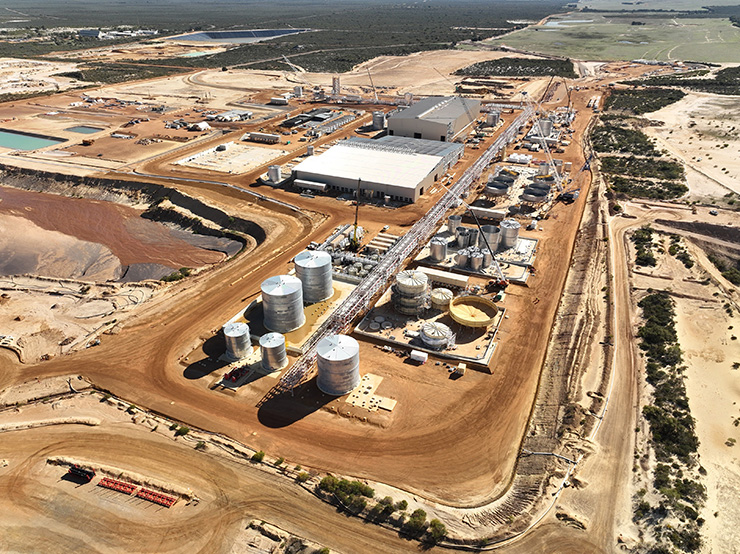
Source: Illuka Resources Eneabba rare earths refinery, Western Australia
“The threat posed to Western and like-minded manufacturing by China’s near monopoly has been self-evident for some time,” says Iluka’s Chief Financial Officer and Head of Development, Adele Stratton. This risk was central to both the government’s approach and Iluka’s decision to partner to develop Australia’s first fully-integrated rare earths refinery, Stratton explains.
The refinery, with a commissioning target of mid-2027, will produce light and, critically, heavy rare earth oxides, including neodymium, praseodymium, dysprosium and terbium (PDF 758KB), essential to high-tech electronics and aerospace manufacturing. Securing supply of refined products is the foundation of an independent supply chain.
“The refinery puts us at the forefront of both the electrification megatrend and the diversification of supply chains, which is now accelerating,” Stratton says. “Previously, Australian and other rare earths would have to be refined by China.”
It’s a strategic asset that enables value-adding for rare earths domestically and brings industry-building potential. In time, it may also enable further steps along the supply chain, such as metallisation, the next stage of value-adding after oxide production and the essential precursor to magnet manufacturing. Iluka is currently undertaking a feasibility study into metallisation, Stratton reveals.
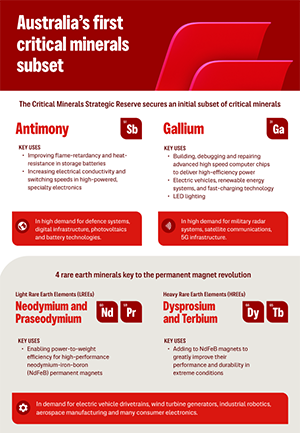
Sovereign resilience, as well as uplift in trade, were behind the recent legislative changes to the remit of Export Finance Australia (EFA), which now has new powers to underwrite purchases, introduce a floor price mechanism to protect domestic producers, secure offtake agreements with other countries and selectively stockpile essential materials, including critical minerals, fuel and rare earths.
Download our critical minerals infographic:
A slice of the action
The race to shore up critical minerals has also led to Australia signing a AUD 4.6 billion deal in 2025 with the United States that guarantees long-term supply of minerals and rare earths considered critical to defence and electric vehicle manufacturing.
Under the deal, Australia and the US each agreed to pump at least USD 1 billion of investment towards a USD 8.5 billion priority project pipeline, including USD 200 million to a West Australian gallium plant owned by Alcoa and USD 100 million to the Arafura Nolans rare earths mine in the Northern Territory.
The US is accumulating reserves of critical minerals through its Project Vault initiative, while other nations, including Japan, Canada and members of the European Union (EU), are also stockpiling. The Australia-EU trade agreement will eliminate EU tariffs on Australian critical minerals when it comes into force.
Ink is now drying on an AUD 220 million offtake deal between Iluka and an unnamed “globally recognised automotive company”, the first customer for its AUD 1.8 billion Western Australian refinery. Iluka’s first binding rare earths offtake is a four-year take-or-pay agreement from 2028 for 1,200 tonnes of magnet rare earth oxides. It provides minimum revenue of USD 155 million, with pricing set at the higher of agreed minimum or market-linked prices.
Further evidence of phenomenal mining sector growth also has come with Alcoa’s Q2 2026 posting of record quarterly revenue of USD 4.0 billion. Alcoa has agreed to acquire South32’s interests in selected bauxite, alumina and aluminium assets, subject to shareholder and regulatory approvals.
Funding for the future
The shift from a globalised to a multipolar world presents massive opportunities for Australia. While final details of the CMSR are yet to be released, time is of the essence when it comes to securing funding for critical minerals projects, says Andrew Strongman, Global Head, Mining and Metals at Westpac Institutional Bank, although questions remain about how to best mobilise the necessary capital to bring these projects to life.
Critical minerals projects can face financing constraints that differ from those in established bulk-commodity markets. Long development timelines, construction and technology risk, concentrated customer bases and limited price transparency can make future cash flows harder to assess.
Government mechanisms such as long-term offtake agreements and contracts for difference can help address price and demand uncertainty in selected markets. Their role is not to replace private capital, but to improve the conditions under which it can participate.
"The challenge is not simply the availability of capital," Toone says. "Projects need credible sponsors, robust execution plans and bankable revenue arrangements. Long-term offtake and appropriately designed government mechanisms can help reduce uncertainty and mobilise private finance."
Westpac can support eligible projects through corporate and project finance, transaction banking and market-risk solutions, subject to the characteristics and stage of each project and the bank's normal assessment and approvals.
“Banks have extensive resource sector expertise, while some critical minerals projects present less mature markets, limited price discovery and processing risks,” Strongman notes.
While mining companies have recognised the challenges of unlocking these projects, pricing is “a complex beast” as the value for commodities is being determined by government policies and international alliances rather than standardised market prices.
“Targeted government mechanisms can improve bankability where market structure does not yet provide sufficiently durable price or demand signals. Westpac is committed to working with government and industry to support bankable projects through financing, transaction banking and risk management, subject to normal assessment and approvals,” Strongman adds.
Westpac’s Commodities team brings deep experience in financing and mining and is currently working with clients across the sector on financing and risk management solutions.
“Depending on the project and its stage of development, that can include corporate or project finance, transaction banking and products to manage commodity price, currency and other market risks,” Toone says.
“The challenge is not simply the availability of capital. Projects need credible sponsors, robust execution plans and bankable revenue arrangements. Long term offtake and appropriately designed government mechanisms can help reduce price and demand uncertainty and mobilise bank finance.”
In the highly competitive market for critical minerals, with nations across the world now building stockpiles, every day counts, concludes Strongman. “Coordinated policy, credible offtake and disciplined project development are needed to convert resource potential into operating supply chains.”
Stay informed with Westpac IQ
Get the latest reports straight to your inbox.
Related articles

Browse topics
Disclaimer
©2026 Westpac Banking Corporation ABN 33 007 457 141 (including where acting under any of its Westpac, St George, Bank of Melbourne or BankSA brands, collectively, “Westpac”). References to the “Westpac Group” are to Westpac and its subsidiaries and includes the directors, employees and representatives of Westpac and its subsidiaries.
Things you should know
We respect your privacy: You can view the New Zealand Privacy Policy here, or the Australian Group Privacy Statement here. Each time someone visits our site, data is captured so that we can accurately evaluate the quality of our content and make improvements for you. We may at times use technology to capture data about you to help us to better understand you and your needs, including potentially for the purposes of assessing your individual reading habits and interests to allow us to provide suggestions regarding other reading material which may be suitable for you.
This information, unless specifically indicated otherwise, is under copyright of the Westpac Group. None of the material, nor its contents, nor any copy of it, may be altered in any way, transmitted to, copied of distributed to any other party without the prior written permission of the Westpac Group.
Disclaimer
This information has been prepared by Westpac and is intended for information purposes only. It is not intended to reflect any recommendation or financial advice and investment decisions should not be based on it. This information does not constitute an offer, a solicitation of an offer, or an inducement to subscribe for, purchase or sell any financial instrument or to enter into a legally binding contract. To the extent that this information contains any general advice, it has been prepared without taking into account your objectives, financial situation or needs and before acting on it you should consider the appropriateness of the advice. Certain types of transactions, including those involving futures, options and high yield securities give rise to substantial risk and are not suitable for all investors. We recommend that you seek your own independent legal or financial advice before proceeding with any investment decision.
This information may contain material provided by third parties. While such material is published with the necessary permission none of Westpac or its related entities accepts any responsibility for the accuracy or completeness of any such material. Although we have made every effort to ensure this information is free from error, none of Westpac or its related entities warrants the accuracy, adequacy or completeness of this information, or otherwise endorses it in any way. Except where contrary to law, Westpac Group intend by this notice to exclude liability for this information. This information is subject to change without notice and none of Westpac or its related entities is under any obligation to update this information or correct any inaccuracy which may become apparent at a later date. This information may contain or incorporate by reference forward-looking statements. The words “believe”, “anticipate”, “expect”, “intend”, “plan”, “predict”, “continue”, “assume”, “positioned”, “may”, “will”, “should”, “shall”, “risk” and other similar expressions that are predictions of or indicate future events and future trends identify forward-looking statements. These forward-looking statements include all matters that are not historical facts. Past performance is not a reliable indicator of future performance, nor are forecasts of future performance. Whilst every effort has been taken to ensure that the assumptions on which any forecasts are based are reasonable, the forecasts may be affected by incorrect assumptions or by known or unknown risks and uncertainties. The ultimate outcomes may differ substantially from any forecasts.
Conflicts of Interest: In the normal course of offering banking products and services to its clients, the Westpac Group may act in several capacities (including issuer, market maker, underwriter, distributor, swap counterparty and calculation agent) simultaneously with respect to a financial instrument, giving rise to potential conflicts of interest which may impact the performance of a financial instrument. The Westpac Group may at any time transact or hold a position (including hedging and trading positions) for its own account or the account of a client in any financial instrument which may impact the performance of that financial instrument.
Author(s) disclaimer and declaration: The author(s) confirms that (a) no part of his/her compensation was, is, or will be, directly or indirectly, related to any views or (if applicable) recommendations expressed in this material; (b) this material accurately reflects his/her personal views about the financial products, companies or issuers (if applicable) and is based on sources reasonably believed to be reliable and accurate; (c) to the best of the author’s knowledge, they are not in receipt of inside information and this material does not contain inside information; and (d) no other part of the Westpac Group has made any attempt to influence this material.
Further important information regarding sustainability-related content: This material may contain statements relating to environmental, social and governance (ESG) topics. These are subject to known and unknown risks, and there are significant uncertainties, limitations, risks and assumptions in the metrics, modelling, data, scenarios, reporting and analysis on which the statements rely. In particular, these areas are rapidly evolving and maturing, and there are variations in approaches and common standards and practice, as well as uncertainty around future related policy and legislation. Some material may include information derived from publicly available sources that have not been independently verified. No representation or warranty is made as to the accuracy, completeness or reliability of the information. There is a risk that the analysis, estimates, judgements, assumptions, views, models, scenarios or projections used may turn out to be incorrect. These risks may cause actual outcomes to differ materially from those expressed or implied. The ESG-related statements in this material do not constitute advice, nor are they guarantees or predictions of future performance, and Westpac gives no representation, warranty or assurance (including as to the quality, accuracy or completeness of the statements). You should seek your own independent advice.
Additional country disclosures:
Australia: Westpac holds an Australian Financial Services Licence (No. 233714). You can access Westpac’s Financial Services Guide here or request a copy from your Westpac point of contact. To the extent that this information contains any general advice, it has been prepared without taking into account your objectives, financial situation or needs and before acting on it you should consider the appropriateness of the advice.
New Zealand: In New Zealand, Westpac Institutional Bank refers to the brand under which products and services are provided by either Westpac (NZ division) or Westpac New Zealand Limited (company number 1763882), the New Zealand incorporated subsidiary of Westpac ("WNZL"). Any product or service made available by WNZL does not represent an offer from Westpac or any of its subsidiaries (other than WNZL). Neither Westpac nor its other subsidiaries guarantee or otherwise support the performance of WNZL in respect of any such product. WNZL is not an authorised deposit-taking institution for the purposes of Australian prudential standards. The current disclosure statements for the New Zealand branch of Westpac and WNZL can be obtained at the internet address www.westpac.co.nz.
Singapore: This material has been prepared and issued for distribution in Singapore to institutional investors, accredited investors and expert investors (as defined in the applicable Singapore laws and regulations) only. Recipients of this material in Singapore should contact Westpac Singapore Branch in respect of any matters arising from, or in connection with, this material. Westpac Singapore Branch holds a wholesale banking licence and is subject to supervision by the Monetary Authority of Singapore.
Fiji: Unless otherwise specified, the products and services for Westpac Fiji are available from www.westpac.com.fj © Westpac Banking Corporation ABN 33 007 457 141. This information does not take your personal circumstances into account and before acting on it you should consider the appropriateness of the information for your financial situation. Westpac Banking Corporation ABN 33 007 457 141 is incorporated in NSW Australia and registered as a branch in Fiji. The liability of its members is limited.
Papua New Guinea: Unless otherwise specified, the products and services for Westpac PNG are available from www.westpac.com.pg © Westpac Banking Corporation ABN 33 007 457 141. This information does not take your personal circumstances into account and before acting on it you should consider the appropriateness of the information for your financial situation. Westpac Banking Corporation ABN 33 007 457 141 is incorporated in NSW Australia. Westpac is represented in Papua New Guinea by Westpac Bank - PNG - Limited. The liability of its members is limited.
U.S.: Westpac operates in the United States of America as a federally licensed branch, regulated by the Office of the Comptroller of the Currency. Westpac is also registered with the US Commodity Futures Trading Commission (“CFTC”) as a Swap Dealer, but is neither registered as, or affiliated with, a Futures Commission Merchant registered with the US CFTC. The services and products referenced above are not insured by the Federal Deposit Insurance Corporation (“FDIC”). Westpac Capital Markets, LLC (‘WCM’), a wholly-owned subsidiary of Westpac, is a broker-dealer registered under the U.S. Securities Exchange Act of 1934 (‘the Exchange Act’) and member of the Financial Industry Regulatory Authority (‘FINRA’). In accordance with APRA's Prudential Standard 222 'Association with Related Entities', Westpac does not stand behind WCM other than as provided for in certain legal agreements between Westpac and WCM and obligations of WCM do not represent liabilities of Westpac.
This communication is provided for distribution to U.S. institutional investors in reliance on the exemption from registration provided by Rule 15a-6 under the Exchange Act and is not subject to all of the independence and disclosure standards applicable to debt research reports prepared for retail investors in the United States. WCM is the U.S. distributor of this communication and accepts responsibility for the contents of this communication. Transactions by U.S. customers of any securities referenced herein should be effected through WCM. All disclaimers set out with respect to Westpac apply equally to WCM. If you would like to speak to someone regarding any security mentioned herein, please contact WCM on +1 212 389 1269. Investing in any non-U.S. securities or related financial instruments mentioned in this communication may present certain risks. The securities of non-U.S. issuers may not be registered with, or be subject to the regulations of, the SEC in the United States. Information on such non-U.S. securities or related financial instruments may be limited. Non-U.S. companies may not be subject to audit and reporting standards and regulatory requirements comparable to those in effect in the United States. The value of any investment or income from any securities or related derivative instruments denominated in a currency other than U.S. dollars is subject to exchange rate fluctuations that may have a positive or adverse effect on the value of or income from such securities or related derivative instruments.
The author of this communication is employed by Westpac and is not registered or qualified as a research analyst, representative, or associated person of WCM or any other U.S. broker-dealer under the rules of FINRA, any other U.S. self-regulatory organisation, or the laws, rules or regulations of any State. Unless otherwise specifically stated, the views expressed herein are solely those of the author and may differ from the information, views or analysis expressed by Westpac and/or its affiliates.
UK: The London branch of Westpac is authorised in the United Kingdom by the Prudential Regulation Authority (PRA) and is subject to regulation by the Financial Conduct Authority (FCA) and limited regulation by the PRA (Financial Services Register number: 124586). The London branch of Westpac is registered at Companies House as a branch established in the United Kingdom (Branch No. BR000106). Details about the extent of the regulation of Westpac’s London branch by the PRA are available from us on request.
This communication is not being made to or distributed to, and must not be passed on to, the general public in the United Kingdom. Rather, this communication is being made only to and is directed at (a) those persons falling within the definition of Investment Professionals (set out in Article 19(5) of the Financial Services and Markets Act 2000 (Financial Promotion) Order 2005 (the “Order”)); (b) those persons falling within the definition of high net worth companies, unincorporated associations etc. (set out in Article 49(2)of the Order; (c) other persons to whom it may lawfully be communicated in accordance with the Order or (d) any persons to whom it may otherwise lawfully be made (all such persons together being referred to as “relevant persons”). Any person who is not a relevant person should not act or rely on this communication or any of its contents. In the same way, the information contained in this communication is intended for “eligible counterparties” and “professional clients” as defined by the rules of the Financial Conduct Authority and is not intended for “retail clients”. Westpac expressly prohibits you from passing on the information in this communication to any third party.
European Economic Area (“EEA”): This material may be distributed to you by either: (i) Westpac directly, or (ii) Westpac Europe GmbH (“WEG”) under a sub-licensing arrangement. WEG has not edited or otherwise modified the content of this material. WEG is authorised in Germany by the Federal Financial Supervision Authority (‘BaFin’) and subject to its regulation. WEG’s supervisory authorities are BaFin and the German Federal Bank (‘Deutsche Bundesbank’). WEG is registered with the commercial register (‘Handelsregister’) of the local court of Frankfurt am Main under registration number HRB 118483. In accordance with APRA’s Prudential Standard 222 ‘Association with Related Entities’, Westpac does not stand behind WEG other than as provided for in certain legal agreements (a risk transfer, sub-participation and collateral agreement) between Westpac and WEG and obligations of WEG do not represent liabilities of Westpac. Any product or service made available by WEG does not represent an offer from Westpac or any of its subsidiaries (other than WEG). All disclaimers set out with respect to Westpac apply equally to WEG.
This communication is not intended for distribution to, or use by any person or entity in any jurisdiction or country where such distribution or use would be contrary to local law or regulation.
This communication contains general commentary, research, and market colour. The communication does not constitute investment advice. The material may contain an ‘investment recommendation’ and/or ‘information recommending or suggesting an investment’, both as defined in Regulation (EU) No 596/2014 (including as applicable in the United Kingdom) (“MAR”). In accordance with the relevant provisions of MAR, reasonable care has been taken to ensure that the material has been objectively presented and that interests or conflicts of interest of the sender concerning the financial instruments to which that information relates have been disclosed.
Investment recommendations must be read alongside the specific disclosure which accompanies them and the general disclosure which can be found here. Such disclosure fulfils certain additional information requirements of MAR and associated delegated legislation and by accepting this communication you acknowledge that you are aware of the existence of such additional disclosure and its contents.
To the extent this communication comprises an investment recommendation it is classified as non-independent research. It has not been prepared in accordance with legal requirements designed to promote the independence of investment research and therefore constitutes a marketing communication. Further, this communication is not subject to any prohibition on dealing ahead of the dissemination of investment research.